Announcing 2025 Disciples Divinity House Scholars
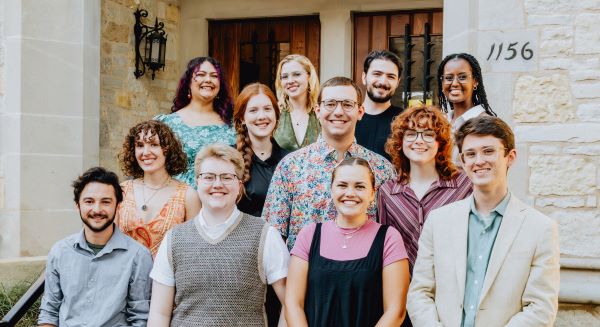
Disciples Scholars commence a lifetime of service and connection, in addition to beginning MDiv, MA, or PhD degree programs at the University of Chicago Divinity School. They receive full tuition, free housing, and stipendiary awards that allow for immersive preparation. Several scholarships honor individuals and extend legacies of thought and action.
New Scholars
Entering MDiv student Annika Fuller is the M. Elizabeth Dey Scholar. She is a 2025 graduate of the New College of Florida. The UCC-related college has a nontraditional curriculum, which allowed her to major in Psychology and Religion while also continuing to pursue music performance. She studied in Germany during her final term. She has been a lifelong member of Palm Lake Christian Church (Disciples of Christ) in Florida, active in regional camps and the regional youth council, and a HELM Leadership Fellow.
Ella Johnson is a first-year MDiv student and has been named The Martin Family Scholar. She was the valedictorian of the 2024 graduating class at Texas Christian University, where she majored in Religion and Politics. A leader of Disciples on Campus at TCU, and involved at University Christian Church and Galileo Church in Fort Worth, she was also a HELM Leadership Fellow and a Be the Neighbor intern. She was raised in the Heart of the Rockies Christian Church in Fort Collins, Colorado.
MDiv student Fiyori Kidane has been named the inaugural recipient of the Jim and Peggy Powell Scholarship. She served from 2023 through this spring as the People-to-People Coordinator for Disciples Overseas Ministries. She is a 2019 graduate of Texas Christian University and a former HELM Leadership Fellow. After graduation, she served as a Global Mission intern in Greece, where she worked with refugees. Fiyori is a member of Allisonville Christian Church in Indianapolis, the Powell’s own congregation.
Allison Nash, beginning the dual degree MDiv/MSW program, is the Oreon E. Scott Entering Scholar and a 2022 BA and MA graduate of Earlham College in English and Education. Until this summer, she served as a librarian at the St. Louis Language Immersion School. In St. Louis, she was active at Union Avenue Christian Church. Her home church is Park Christian Church in New Bedford, Indiana. Serving as a Disciples Peace Intern in summer 2024 catalyzed her decision to apply for MDiv studies. (Not pictured.)
MA student Brandon Roberts has been named the Henry Barton Robison Scholar. Brandon is a 2025 honors graduate of Knox College in Galesburg, Illinois, where he majored in History and Educational Studies. His interests are in biblical studies and critical theory; he has already given several conference papers. Originally from Portland, Oregon, he became a member of the Gerlaw Christian Church while at Knox. He is an accomplished musician and his spouse, Marli Messner, is a poet.
The William N. Weaver Entering Scholar will be MDiv student Hayden Skaggs, a 2025 honors graduate of Eureka College, where he studied Sociology and Religion. He was an intern at Eureka Christian Church and as a Be the Neighbor intern. He was a Lincoln Academy of Illinois Student Laureate, a HELM Leadership Fellow, a Phillips University Leadership Fellow, and a campus leader at Eureka. Last summer, he walked the Camino de Santiago across northern Spain.
Continuing Scholars
Rachel Abdoler, a PhD student in the History of Christianity, is spending several months in Rome and Cairo on a Fullbright-Hays Doctoral Dissertation Research Abroad fellowship, underwriting her work on medieval Christian texts written in Arabic, many of which are housed in collections in the Vatican and in Egypt. She is the Barbara and Clark Williamson Scholar. (Not pictured.)
Delaney Beh, a third-year MDiv student, continues as the M. Ray and Phyllis Schultz Scholar. They served this past summer as the sabbatical intern for alumnae Thandiwe Dale-Ferguson at First Congregational Church in Loveland, Colorado.
Entering her second year in the MDiv program, Grace Dearhamer is the Drum and Tenant Scholar. She spent the summer working with the National Council of Churches disaster relief and recovery programs in the Philippines.
MariaIsabelle Garcia, a second-year MDiv and DDH scholar, was an intern at Allisonville Christian Church in Indianapolis this summer, working with alums Sarah Zuniga and Beau Underwood, and is doing her field placement at University Church. She is the Dr. Geunhee and Mrs. Geunsoon Yu Scholar.
Second-year MDiv student, Hart Lang, is the Edward Scribner Ames Scholar. He has an MFA from Rutgers University-Camden and came to DDH from Gilead Church in Chicago.
The Rolland & Laura Frances Sheafor Scholar is Tristan Spangler-Dunning, a third-year MDiv student. He spent last summer working on a history of the Pension Fund. His field education placement is with the Proclamation Project (?).
Katie Varon, second-year MDiv and Head Resident, is the William Barnett Blakemore Scholar. Katie spent the summer working with the National Council of Churches disaster relief and recovery programs in the Philippines.
The Bernard F. and Annie Mae Cooke Scholar is Emma Yeager, a second-year MA student, studying themes of ecology in medieval theology and literature, with an interest in museum work. This past summer, she interned with the Institute for the Study of Ancient Cultures, formerly known as the Oriental Institute.
The William Daniel Cobb Alumni/ae Scholarship enabled nine current and recent Scholars to attend the 2025 General Assembly of the Christian Church (Disciples of Christ) in Memphis, Tennessee: Fiyori Kidane, Allison Nash, Hayden Skaggs, Grace Dearhamer, Katie Varon, Tristan Spangler-Dunning, Virginia White, Isabelle Garcia, and Morganne Talley. They participated in business sessions, educational opportunities, and worship – and made connections with alums.
2025 Entering Scholars Announced
.jpg?mtime=1756318790 "{alt_text}")
Six individuals have been named new Disciples Divinity House Scholars. They enter MDiv and MA programs at the University of Chicago Divinity School. Clockwise from the top left, they are:
Ella Johnson (MDiv) was the valedictorian of the 2024 graduating class at Texas Christian University, where she majored in Religion and Politics. A leader of Disciples on Campus at TCU, and involved at University Christian Church and Galileo Church in Fort Worth, she was also a HELM Leadership Fellow and a Be the Neighbor intern. She was raised in the Heart of the Rockies Christian Church in Fort Collins, Colorado.
Brandon Roberts (MA) is a 2025 honors graduate of Knox College in Galesburg, Illinois, where he majored in History and Educational Studies. His interests are in biblical studies and critical theory; he has already given several conference papers. Originally from Portland, Oregon, he became a member of the Gerlaw Christian Church while at Knox. He is an accomplished musician and his spouse, Marli Messner, is a poet.
Annika Fuller (MDiv) is a 2025 graduate of the New College of Florida. The UCC-related college has a nontraditional curriculum, which allowed her to major in Psychology and Religion while also continuing to pursue music performance. She studied in Germany during her final term. She has been a lifelong member of Palm Lake Christian Church (Disciples of Christ) in Florida, active in regional camps and the regional youth council, and a HELM Leadership Fellow.
Allison Nash (MDiv) is a 2022 BA and MA graduate of Earlham College in English and Education. She has been serving as a librarian at the St. Louis Language Immersion School. In St. Louis, she was active at Union Avenue Christian Church. Her home church is Park Christian Church in New Bedford, Indiana. Serving as a Disciples Peace Intern in summer 2024 catalyzed her decision to apply for MDiv studies. Allison plans to pursue the dual MDiv/MSW degree program and has already been accepted by the Crown School.
Fiyori Kidane (MDiv) served from 2023 through this spring as the People-to-People Coordinator for Disciples Overseas Ministries. She is a 2019 graduate of Texas Christian University and a former HELM Leadership Fellow. After graduation, she served as a Global Mission intern in Greece, where she worked with refugees. Her home congregation is Allisonville Christian Church in Indianapolis.
Hayden Skaggs (MDiv) is a 2025 honors graduate of Eureka College, where he studied Sociology and Religion. He has been preparing for leadership in congregational, multi-religious, and academic contexts, including as an intern at Eureka Christian Church and as a Be the Neighbor intern. He was a Lincoln Academy of Illinois Student Laureate, a HELM Leadership Fellow, a Phillips University Leadership Fellow, and a campus leader at Eureka. This summer, he walked the Camino de Santiago across northern Spain.
This fall, they will join nine continuing scholars, five new ecumenical residents, and seven returning residents.
In memoriam: Donald Aubrey Leak
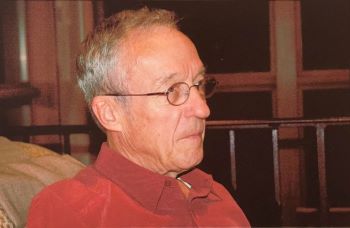
Donald Aubrey Leak, entering class of 1960, died July 21 in the Seattle area. He was 89.
Born in Indiana on September 20, 1935, Don earned his BS degree at the Indiana University. He met Joyce Weigel, a fellow student at Indiana University, and they married in 1957. He continued to Divinity School, becoming a Disciples Divinity House Scholar in 1960 and earning his BD from Chicago Theological Seminary. During his career served as an administrator for religious and nonprofit organizations, including for the Roman Catholic Archdiocese of Seattle and for the YMCA. He and Joyce retired in the Seattle area and remained active as a DDH alumnus. He is survived by his wife and their two sons, David and Bruce.
Learning about disaster response and sustainable development in the Philippines
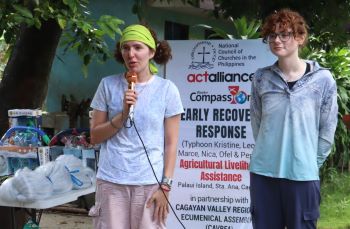
The National Council of Churches in the Philippines (NCCP) is a bilateral partner of the Week of Compassion through Global Ministries and ACT Alliance. As their disaster response to a devastating typhoon transitioned from emergency relief to long-term recovery, the partnership deepened to include an internship that places Disciples seminarians alongside their recovery team to learn directly from NCCP’s work and accompany communities as they rebuild. MDiv students and DDH Scholars, Grace Dearhamer and Katie Varon, recently arrived in the Philippines to work and learn for 6-8 weeks.
Grace comments, I am eager to engage with communities on the front lines of environmental and social justice, learning firsthand from their experiences and resilience.This experience will be instrumental in shaping my vocational path. Katie, who was able to participate in ACT Assembly in Indonesia last fall, notes: I am attracted to the specificity of this program because it showcases an intentional goal of equipping emerging Disciples leaders to connect our faith and our actions by learning from people who are already doing so.
The ordination of Morganne Talley
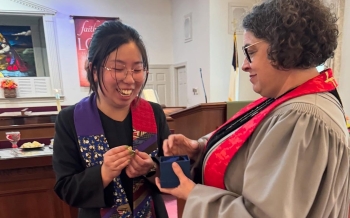
Morganne Talley, 2025 MDiv graduate, was ordained to the Christian ministry on July 26 at Timberlake Christian Church in Lynchburg, Virginia. She is wearing a stole that her family commissioned for her. Stephanie McLemore, also an alumna and Morganne's undergraduate chaplain at the University of Lynchburg, preached. McLemore is now Director of Religious Life and University Chaplain at Denison University in Ohio. Student colleagues, Tristan Spangler-Dunning, Isabelle Garcia, and Delaney Beh were among participants. Bill Spangler-Dunning, Regional Minister in Virginia, presided.
In memoriam: Edward H. Kolbe
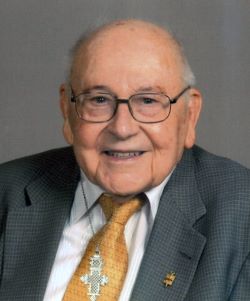
Edward H. Kolbe, entering class of 1956, died July 10 in Lincoln, Nebraska. He was 91. A congregational pastor for forty years, he was a specialist in evangelism and an enthusiast of reading, gardening, football, current events, public television, and TCU's Horned Frogs. He dubbed himself "Boy Recruiter" and regularly sent students to DDH.
Ed Kolbe was born in Cypress, Texas, on June 8, 1934, to Louis and Emilie Kolbe. In 1956, after graduating from the University of Houston, he entered the University of Chicago as a Disciples House Scholar. “I was the last Disciples student of Dr. W.E. Garrison while he was teaching religion and philosophy at the University of Houston,” Mr. Kolbe remembered. (W.E. Garrison had served as the second dean of Disciples Divinity House from 1921-28.) “This was the catalyst for a lifetime of influence of Disciples House in my life.”
Ed served churches in Wichita Falls, TX; Warrensburg, OH; Bedford, IN; Lincoln; Corvallis, OR; Seattle; and Arlington, TX. He earned a DMin at Christian Theological Seminary. He and Mary Ruth Judd married in 1961; she died in 2017. Mary Ruth taught nursing at universities and community colleges. During their fifty-five years of marriage, led educational tours to Israel and Europe, and volunteered in many clubs and organizations. Ed was active in Kiwanis wherever he lived, and served three separate terms on the DDH Alumni/ae Council.
He is survived by three children, Ruth Cooper (Brian), Charles Thornton-Kolbe (Jennifer), and Tom Kolbe (Laura Salem), and six grandchildren. In 2019, his family joined with him to establish the Edward H. and Mary Ruth Judd Kolbe Fund in celebration of his 85th birthday and DDH's 125th year.
Kidane named first Jim & Peggy Powell Scholar

Entering DDH Scholar Fiyori Kidane has been named the inaugural recipient of the Jim and Peggy Powell Scholarship. From 2023 until recently, Fiyori served as the People-to-People Program Coordinator for Global Ministries. After graduating from Texas Christian University in 2019, she served as a Global Mission Intern with Perichoresis, a program of the Evangelical Church of Greece, where she worked with migrant and refugee communities and in administrative support. Fiyori will be one of six new entering DDH Scholars this fall.
This scholarship honors the ministry and leadership of James L. and Margaret Powell and expresses their lifelong desire to find, support, and educate leaders for the church to serve the world. Much of Jim's ministry in the Christian Church (Disciples of Christ) was through Church Extension, which he served as President. After retirement, Jim worked extensively with DDH to undergird and embolden its mission.
The scholarship, which will help ensure full tuition, stipend, and housing support, was spurred by the Powells' children, Drew, Than, Elisabeth, and Laura, and by family friend Gaylord Yu. Other family members, colleagues, and friends joined to raise the $250,000 endowment. The Powells were delighted to learn that Fiyori Kidane, who is a member of Allisonville Christian Church in Indianapolis, their own congregation, has been named the first recipient.
Ilnitzki honored with Rhind Award

Marissa Ilnitzki, a Disciples House Scholar and June graduate of the MDiv and MSW programs, was honored with the 2025 Joseph Gray Rhind Award at the Divinity School's pinning and hooding ceremony on June 6. Each year a recipient is selected from MDiv graduates for their excellence in training and promise for religious leadership.
The following comments are adapted from the award presentation. Marissa's MDiv cohort knows her as a deep listener, a skilled interlocutor, and a committed friend: as one who pays close attention to others and in whose presence they feel seen, heard, and respected. At Northwestern Hospital, where Marissa trained and continued to work shifts as a hospital chaplain, patients experienced a sense of dignity and understanding among her abundant gifts for spiritual care. Her care for persons and communities is matched and sustained by her lively intellectual curiosity, courage, and love for the arts.
Her skill and insight were powerfully articulated in her MDiv thesis, “A Postcolonial Image: What Hospital Chaplaincy Can Learn from the Art, Theory, and Practice of Improvisation.” In the thesis, Marissa paired her training in improvisation (including at Second City) with research into its use in social work at Hull House, and the felt similarities with moments of jointly crafting theological and care giving responses to illness, grief, and change. She advocates for chaplains and other caregivers to use improv exercises to “ground themselves in humility, remind themselves of the limits of their knowledge, take in new information, and trust that each person has something unique and beautiful to contribute to our mutual understanding.”
Ilnitzki is pictured in the center, with a fellow DDH scholar, Justin Carlson, and resident, Halley Haruta.
Ordained to service, scholarship, and ministry

Virginia Johnston White was ordained to the ministry in the Christian Church (Disciples of Christ) on May 31 in DDH's Chapel of the Holy Grail. Gathered for the joyous celebration were family members, friends, and colleagues from local, regional, general, global, and ecumenical manifestations of the church and from the academy. William Schweiker preached; he is the Edward L. Ryerson Distinguished Service Professor of Theological Ethics at the Divinity School, a United Methodist minister, and Virginia's dissertation advisor.
After a welcome by Dean Kris Culp, the service was convened through the words and prayers of Colton Lott and Cynthia Lindner. Virginia's mother, Rev. Mary Lu Johnston, gave the ordination prayer. Participants included Associate General Minister Yvonne Gilmore, Executive Director of Week of Compassion Vy Nguyen, Bethany Fellows Director Aneesah Ettress Veatch, Regional Minister Rick Hamilton, and representatives of Virginia's sponsoring and home congregations, Root + Branch in Chicago and University Christian Church in Austin, Texas. The service culminated with Virginia--newly ordained, fitted with the signs of the office, and joined by her father, Ted White--presiding over communion and giving the benediction. Crowning the service was a glorious postlude of Widor's Toccata from Symphony No. 5 by guest organist Patrick Scott.
The Head Residents

Four generations of Head Residents were present for the final Monday dinner of the academic year. Sarath Pillai (served 2021-22), a historian of modern India who is now the A. Kenneth Pye Visiting Assistant Professor of South Asian Studies at SMU, had returned to visit. Justin Carlson (2022-23) and Kylie Winger (2023-25) will graduate in June with MDiv degrees. Katie Varon, a rising second-year House Scholar and MDiv student, has been named the next Head Resident. DDH is grateful for their leadership.
From achievement culture to kids’ ministry, improv, table ethics, and more

Senior Ministry Projects are an important feature of the Divinity School's MDiv program, as well as an opportunity for vocational exploration and theological expression. They involve a forty-page written thesis and a public presentation. Five Disciples Scholars together with another DDH resident are presenting their work this spring.
On Friday, May 16, Tyler Ashman spoke at 5pm in the Swift Hall lecture room on "Judging Faithfully: Law and moral conviction in the federal judiciary." Tyler, a MDiv/JD dual degree student, will begin a clerkship with a federal judge after graduation.
Justin Carlson (see photo) has been exploring ecological approaches to biblical interpretation. He presented his project,"Reading Among Reeds: Interpreting scripture in post-industrial ecology," at Big Marsh Park, on May 10 and 14. The area, which is in South Chicago, just off the eastern banks of Lake Calumet, has been partially restored after suffering industrial pollution.
On May 5, Nate Travis combined a dinner experience with a formal presentation to consider Whose table? Which ethics? Food and eating as ethical practice. First, guests sat down for a Monday Night Dinner, where Nate assigned seats at random and asked attendees to serve food to an immediate neighbor instead of themselves. He explained the concept of "foodways" across religions and culture and shared two case studies to illustrate the delicate practice of negotiating differences across a table.
Marissa Ilnitzki presented her project on April 28: What hospital chaplaincy can learn from the art, theory, and practice of improvisation? This question emerged from her felt recognition of similarities when crossing the threshold into a patient's room as a chaplain and when entering into an improv skit. She spoke of postcolonial models for multi-faith hospital chaplaincy, as well as deep into the history of improvisation through Second City and back to Hull House, primarily in the person of Viola Spolin. Marissa invited her audience to try a variety of improv games and scenes, at first to great trepidation and then to great laughter.
On April 21, Morganne Talley presented her project, focused on the unwelcome potential for creating religious trauma in kids' ministry and what can be done to prevent it. She worked with a Disciples pastor to develop a baptism class for a Disciples congregation, hence the project's title: From Hell to Holy Water: A trauma-informed paradigm for kids' ministry. She included a "Sword Drill" demonstration in her presentation: under pressure, three volunteers competed to see how quickly they could locate a Bible citation, most often about sin and wickedness! Morganne emphasized the importance of raising children, not with a "wall"-like faith (strong, but rigid and brittle), but with a "web"-like faith (strong, stretchable and flexible). Thirty people Zoomed into Morganne's presentation from across the country.
On April 14, Kylie Winger presented her Senior Ministry Project, Already Enough: Countering achievement culture in the creative writing classroom. She began by inviting her audience into two short exercises, and by allowing her audience to experience her presence as a teacher. She discussed the achievement culture she has encountered in the high school classroom and the spiritual dimensions of her work. She explored and demonstrated approaches to encourage curiosity, experimentation, and creativity. In the fall she will begin as a theology teacher at DePaul College Prep in Chicago.
Steinbrecher passes the secretary pen to Wood

In 2015, Paul Steinbrecher was elected Secretary of the Board of Trustees and to its Executive Committee. Now retired as a principal at Interactive Design, Inc. (IDEA), a Chicago-based architecture firm. Paul first became associated with DDH in 1995 because of his expertise in historic preservation and cultural and religious institutions. He was elected to the Board in 2012 and quickly became as indispensable to its work as he was already to the well-being of the building. After serving as secretary for ten years, he has handed over those duties while continuing his trustee work as a member of the House Committee.
Melinda Keenan Wood has picked up the pen. She was first elected to the Board of Trustees in 2019 after serving as President of the Alumni/ae Council. Lindy has been Senior Minister of Pilgrim United Church of Christ in Durham, North Carolina, since 2017. From 2002-17, she was Senior Minister of Pershing Avenue Christian Church in Orlando, Florida. Among the ways she has served the wider church is chairing the Week of Compassion. Lindy came to her MDiv studies with a background in nonprofit work; she was ordained in 2000 at National City Christian Church in Washington, DC.
PhD-Bound

Congratulations to 2025 graduates Nate Travis, Muhammad Hassan, and Kevin Poe, who have accepted offers to study at the University of Oregon (Philosophy and Ecology), the University of Chicago Divinity School (Religions in the Americas), and University of California-Santa Barbara (South Asian Religions).
Dunn to receive Distinguished Alumnus Award

J. Marshall Dunn, Minister Emeritus of University Christian Church, Hyattsville, Maryland, will be honored with the Distinguished Alumnus Award. The Alumni/ae Council will present the award on July 15 at DDH's luncheon at the General Assembly in Memphis.
He has been for me and others what is best of the Disciples of Christ: working towards wholeness, modeling deep Christian spirituality, loving compassion, and a passion for justice, commented one alumna who was one of several who submitted nominations. Another explained, Marshall Dunn is a pastor par excellence. For over 50 years he has led congregations and communities as a rigorous teacher and a practitioner of ministry that cares for the soul with competence and heart.
Marshall Dunn entered the Divinity School as a Disciples Divinity House Scholar in 1965. Encouraging his fellow students in the new DMin program to live at DDH, he helped to usher in the ecumenical student community that exists to this day. He interned at the Coordinating Council of Community Organizations on Chicago's south side. When Dr. King came to Chicago to confront northern racism, Marshall's passion for racial justice grew. After his ordination, he served two south side congregations, which would merge under his leadership. He was the founder of Reach Out, an ecumenical crisis center for families in need. He became the first president of the Illinois-Wisconsin College of Ministers.
In 1974 he was called to University Christian Church near the University of Maryland, where he would serve for 31 years, building a multi-racial and culturally diverse congregation that has been deeply involved in vibrant worship, community outreach, and transformational ministry ever since. He led the church through significant decades in the relation of church and society, which included exemplary participation in Week of Compassion and Reconciliation programs and remarkable local action. For example, in the eighties and nineties, the congregation partnered with the high school next door and the Early Head Start program to support teen moms and their children. In 1991, he was honored with the Brotherhood/Sisterhood Award by the local chapter of the National Conference of Christians and Jews for his service to the community, especially for his efforts on behalf of the poor and his commitment to race relations and social justice. In 1995, he helped to found and then chaired Congregations United in Compassion and Empowerment (CUCE) a non-profit organization that provides a nexus of social services and information for the Prince George's County area that continues to this day.
His commitment to work with youth and young adults is legendary. He has spent the equivalent of more than one year of his life counseling or directing church camps--and only recently retired from that. He has been sought, too, as a mentor to rising generations of ministers. After his retirement in 2006, Dunn provided interim leadership in local congregations, as regional minister in the Capital Area, and as Temporary Associate General Minister and President of the Christian Church (Disciples of Christ).
Dunn was elected to the Board of Trustees in 2012. As chair of its House Committee, he is currently leading efforts to reimagine and renew DDH's two residential floors and to prepare for the future of ministry.
Re-inventing residence: Construction begins this summer
_1200x900.jpg?mtime=1741530418 "{alt_text}")
How can a 1928 Gothic building be readied for a future that is beyond present imagining? How can this old House provide for forms of learning and ministry that we cannot yet glimpse?
To catalyze student living and learning for the next one hundred years, the Board of Trustees has chartered a design and construction team that has expertise with historic buildings and an imagination of future possibilities. Plans focus on more climate resilient and welcoming conditions for the residential floors. Energy efficient air conditioning will not require intrusive mechanicals. All-gender bathrooms will provide private changing areas and more accessible facilities. New flooring and lighting will enhance each student room; old acoustical tile ceilings will be removed; sparkling lights will illuminate the atrium.
In memoriam: Mark G. Toulouse

Disciples Divinity House is saddened to learn of the death of Mark G. Toulouse on March 2. A leading historian and theologian of the Disciples movement, ordained Disciples minister, and expert on Religion and Public Life, he was honored as the Alumnus of the Year by the University of Chicago Divinity School in 2018. A memorial service will be held at South Hills Christian Church in Fort Worth, Texas, on Sunday afternoon, March 9.
Toulouse retired as Principal and Professor of the History of Christianity of Emmanuel College at the University of Toronto in 2017. Under his leadership, several new academic programs were introduced, including the PhD degree, the MA degree, and the Certificate of Spiritual Care and Psychotherapy, all offered conjointly with the University of Toronto. His work has included the creation of Muslim and Buddhist Studies programs. He was also Emeritus Professor of American Religious History at Brite Divinity School, where he taught from 1986 to 2008 and served as Dean and Executive Vice-President from 1999-2002. He began his teaching career at Illinois Benedictine College (1980-84) and served on the faculty of Phillips Theological Seminary from 1984-86.
Mark Toulouse received his PhD in the History of Christianity from the University of Chicago in 1984, where he was a student of Martin E. Marty. Toulouse has written or edited ten books, including Joined in Discipleship: The Shaping of Contemporary Disciples Identity (1992 and 1997); Makers of Christian Theology in America (1997), Sources of Christian Theology in America (1999), Walter Scott: A Nineteenth-Century Evangelical (1999), God in Public (2006), and The Altars Where We Worship: The Religious Significance of Popular Culture (2016). His research and teaching were been supported by grants from the Association of Theological Schools, the Lilly Endowment, the Louisville Institute, the Wabash Centre for Teaching and Learning, the Henry Luce Foundation, and the Connaught Fund at the University of Toronto.
He was serving as a member of the Disciples-ELCA Bilateral Dialogue, which met in Chicago the weekend before his death, and where he brought classic clarity, wisdom, and erudition.
Gilpin remembers Marty

Jaunty bow ties were a perennial feature of his wardrobe, signaling that he took the occasion seriously, but not himself. He entered a room with a quick step and, just as quickly, entered the flow of your life, your questions, and your ideas. He honored the time and space of the conversation.
- W. Clark Gilpin, "Martin Marty's Unfinished Conversations"
Martin E. Marty, the Fairfax M. Cone Distinguished Service Professor Emeritus of the History of Modern Christianity at the Divinity School, died February 25 at the age of 97. He was the author or editor of more than sixty books, including Righteous Empire, which won the National Book Award. He advised 115 dissertations. When he retired in 1998, the Divinity School's Center for the Advanced Study of Religion was renamed the Martin E. Marty Center. His M.E.M.O. column ran in every issue of The Christian Century from 1972 to 2008. More here and here.
Alum Council at work

The Alumni/ae Council welcomes new members to the class of 2028: Mark Miller-McLemore, Andrew Packman, and Sarah Zuniga. Miller-McLemore (entering class of 1975) taught leadership and ministry at Vanderbilt Divinity School for 25 years and served as the dean of DDH@Vandy. Packman (2009) is a theological ethicist and an assistant professor at United Theological Seminary the Twin Cities. Zuniga (2018) is an associate minister of Allisonville Christian Church in Indianapolis and co-moderates the Disciples Peace Fellowship.
The Alumni/ae Council builds relations among alums and keeps alums connected with new Disciples Scholars and with DDH's ongoing mission. Laura Jennison Reed and Aaron Smith are co-presidents of the Council. Other continuing members are Amy Bertschausen, Brandon Cook, Tim Lee, Aneesah Ettress Veatch, Katherine Alexander, Cheryl Jackson, and Carol Sherman. Special thanks to Danielle Cox and Michael Stone, who concluded their service in December.
The Council is in the process of selecting a Distinguished Alumna/us who will be honored at DDH's luncheon on July 15, at the General Assembly in Memphis. Registration for the General Assembly and tickets for the luncheon are available here.
Miller-McLemore explores “calling”

At a DDH Forum on Monday, February 24, Bonnie Miller-McLemore discussed the complexities of calling and vocation--that it can change over our lives, that it can be something we didn't choose, that we can have more than one calling, and that they may conflict. She presented findings from her new book, Follow Your Bliss and Other Lies about Calling (Oxford University Press, 2024). Drawing on memoirs, biographies, and fiction, it guides the reader through six dilemmas one may face throughout life, from missed or conflicted callings to unexpected or relinquished passions. An alumna, she is the E. Rhodes and Leona B. Carpenter Professor of Religion, Psychology, and Culture Emerita at Vanderbilt Divinity School. Pictured with her are (l to r): Kylie Winger, Isabelle Garcia, Miller-McLemore, Morganne Talley, and Delaney Beh.
AI and our humanity

On January 27, DDH will welcome Kristel Clayville and William Schweiker to discuss AI and Our Humanity. Both scholars have addressed the intersection of theological ethics and technology. The 7:00 pm forum will follow Monday dinner.
Clayville, a DDH alumna and PhD graduate of the Divinity School, is an ethicist and member of the Computer Science at the University of Illinois at Chicago. Her current work focuses on the intersection of religion and technology, including information and biotechnologies and the ethics of organ transplants. Her 2024 Genevieve Staudt Intercultural Lecture at Elmhurst University was “Dea Ex Machina: Using Feminine Images of God to Describe AI.” She is also a Senior Fellow at the MacLean Center of Medical Ethics at the University of Chicago and the former Acting Director of the Zygon Center for Religion and Science. She has taught medical ethics, served as member of hospital ethics committees, and worked as a hospital chaplain.
Schweiker is the Edward L. Ryerson Distinguished Service Professor of Theological Ethics at the Divinity School. His scholarship and teaching engage theological and ethical questions attentive to global dynamics, comparative religious ethics, history of ethics, and hermeneutical philosophy. He will keynote an upcoming Yale Divinity School conference, "AI and the Ends of Humanity." He is the author or editor of over twenty books and more than 135 articles. He was Chief Editor of A Companion to Religious Ethics (2004) and is Editor-in-Chief of the Encyclopedia of Religious Ethics (3 vols.). He was awarded an Honorary Doctorate from the University of Uppsala, and has held several international visiting professorships including as Mercator Professor at the Universität Heidelberg, Deutsche Forschungsgemeinschaft. He was President of the Society of Christian Ethics and Director and PI of The Enhancing Life Project (2014-17). Schweiker is an ordained minister in the United Methodist Church and theologian-in-residence at the First United Methodist Church at the Chicago Temple.
Rachel Abdoler awarded Fulbright-Hays fellowship

Rachel Abdoler has been awarded a Fulbright-Hays Doctoral Dissertation Research Abroad (DDRA) fellowship to support her research on thirteenth-century Coptic author’s interpretation of the passion of Christ and its background of Arabic Christian and Islamic writing. Her dissertation is titled Between Defense and Devotion: Butrus al-Sadamanti's Tafsir on the Passion of Christ in its Thirteenth Century Copto-Islamic Milieu. The award will underwrite six months of research work in the fall and winter of 2025-26 in the collections of the Vatican library in Rome and a library in Cairo, Egypt, on Christian texts written in Arabic. Abdoler is a DDH Scholar and a PhD candidate in the History of Christianity at the University of Chicago Divinity School.
Salt of the earth

Joy and Francis Williams were salt of the earth, hardworking Midwesterners. The Christian Church in Clever, Missouri, was central to their lives and their relationship. Over the years they became delegates to Disciples state and regional conventions, focusing primarily on its outreach mission. "Nothing would have given my parents greater delight than knowing that a fund had been established in their honor to help others fulfill their educational dreams," says Ritch Savin-Williams, DDH entering class of 1971. He is now Professor Emeritus of Cornell University and author of ten books on adolescent development, gender, and sexuality. They would have viewed this gift as an expression of their outreach mission to give back what God had so generously given them. Read more here.
Announcing 2024 Disciples Divinity House Scholars
.jpg?mtime=1727356312 "{alt_text}")
Sixteen students have been named Disciples Divinity House Scholars for 2024-25.
Four new Scholars enter the MDiv program: Grace Dearhamer, a 2024 graduate of Eureka College who hails from Oklahoma, was awarded the Drum and Tenant Scholarship, which remembers two women who were “do-ers” in the church. MariaIsabelle Garcia has been awarded the Oreon E. Scott Entering Scholarship. A 2022 graduate of Chapman University, Isabel brings experience in community organizing and with youth in schools. Bernard F. and Annie Mae Cooke Scholar, Hart Lang received his BA from Wake Forest University (2012) and an MFA in Creative Writing from Rutgers Camden (2021). He is a member of Gilead Church in Chicago. Kathleen (Katie) Varon is the William N. Weaver Entering Scholar. A 2024 graduate of Vassar College, she was a HELM Fellow. She grew up in Riverside Avenue Christian Church in Jacksonville, Florida. Entering the MA program is Emma Yeager, a West Virginia native with a strong ecumenical impulse, 2024 graduate of Moody Bible Institute, and aspiring historian and theologian, who has been awarded free housing.
Rachel Abdoler, the Barbara and Clark Williamson Scholar, is writing her PhD dissertation on a thirteenth-century Coptic author’s interpretation of the passion of Christ, and its background of Arabic Christian and Islamic writing. Delaney Beh, a second-year MDiv student and the M. Ray and Phyllis Schultz Scholar, is preparing for chaplaincy. Justin Carlson is the William Daniel Cobb Alumni/ae Scholar. He recently completed a ten-month full-time internship at First Christian Church in Tacoma, Washington, and now begins his final MDiv year. Marissa Ilnitzki, the Martin Family Scholar, is a fourth-year dual MDiv/MSW student preparing for chaplaincy. She will be the chapel speaker in November. Kevin Poe, a second-year MA student, was awarded the Henry Barton Robison Scholarship. This summer, he studied Sanskrit in Pune, India, and visited Buddhist/Hindu pilgrimage sites in northern India to conduct interviews. Luke Soderstrom is exploring how theological concepts of children shaped Moravian piety in his PhD dissertation. Tristan Spanger-Dunning has transferred to the MDiv program and enters his second year. A recipient of the Rolland and Laura Frances Sheafor Scholarship, he completed an internship this summer with the Disciples of Christ Historical Society this summer. Third-year MDiv Morganne Talley is the Dr. Geunhee and Mrs. Geunsoon Yu Scholar, which honors two outstanding Disciples leaders. She completed CPE at Rush University Medical Center this summer. Nate Travis, also a third-year MDiv, is the Blakemore Scholar, and was the DDH House Council President last year. He presented a paper at the Oxford Institute (UK) for Methodist Theological Studies in August. Virginia White, the E. S. Ames Scholar, is writing her dissertation on “Reckoning with Social Evils: Performativity as a Foundation for Reenvisioning Lament and Laughter as Moral Practices.” In August, she presented a paper in Denmark; she will speak at the Ricoeur conference in Chicago in October. Kylie Winger, a third-year MDiv who is a creative writing and teacher of writing, is also DDH’s Head Resident. She received the M. Elizabeth Dey Scholarship, created by Katherine Dey to remember her grandmother, who raised her and helped start a Disciples congregation in Arlington, Virginia.
In memoriam: Charles R. Blaisdell

Charles R. (Chuck) Blaisdell died September 22, 2024, in Massachusetts. Chuck was a current member of the DDH Alumni/ae Council. His intelligence, leadership, and camaraderie graced the Christian Church (Disciples of Christ)--from regions and congregations, to theological education and general ministries, as well as many friends and colleagues.
Born in Fort Worth, he graduated from Texas Christian University (BA). He studied philosophy at Vanderbilt University (ABD) and earned the MA degree. In 1976, he became a Disciples Divinity Scholar and was awarded the AMRS degree from the University of Chicago Divinity School. Christian Theological Seminary in Indianapolis awarded him the MDiv and, in 2012, an honorary Doctor of Divinity degree.
In more than forty years in ministry, he was minister of First Christian Church in Monahans, Texas, Stylesville Christian Church (Indiana), Hilo Coast United Church of Christ (Hawai’i), and First Christian Church of Colorado Springs. He was a lay leader at First Church Sterling, Massachusetts. He served as the regional minister of Northern California-Nevada and the associate regional minister of Indiana. He also worked for UCC Church Building and Loan Fund, Week of Compassion, and the the Christian Board of Publication in development.
Chuck was sought after as a mentor, polity expert, and theologian. He published a number of sermons, articles, and book reviews, and edited Conservative, Moderate, Liberal: The Biblical Authority Debate (Chalice Press). Read his introduction to Clark Williamson's distinguished alumnus address here. He was a director emeritus of and served on the board of directors of Higher Education & Leadership Ministries. Chuck was a voracious reader, enjoyed piloting his Cessna 150 and, later, listening to air traffic control. He moderated numerous online forums and appreciated puns, both terrible and clever.
He was, according to his dear friend Bob Hill, "a steadfast champion for the best practices and attitudes ministers can embody--across the face of the shifting tides of technology, the call to grow in all dimensions of ecclesial life, the rigor, integrity to which all clergy are called, the need for fiduciary integrity on all levels of church life, and so much more."
He is survived by his wife, Barbara (Shires) Blaisdell; his brother, Jim Blaisdell; his hanai brother, Bob Hill; his children, Micah Shires-Taylor, Rebecca (Shires-Taylor) DeWeese, Andrew Blaisdell, Katherine Blaisdell, and their spouses; and three grandchildren. He was preceded in death by his parents, Hazel (Carr) and Richard Blaisdell, and his brother, Greg Blaisdell. Services will be held at the First Church of Sterling, Massachusetts, on a date to be announced.
2024 Entering Scholars announced

This year, DDH welcomes five entering MDiv and MA students as Disciples Scholars. Clockwise starting at the bottom left of the picture, they are:
Grace Dearhamer (MDiv) grew up in many places, including four years in London, England, before her family moved to Broken Arrow, Oklahoma. Her home church is Forest Park Christian Church in Tulsa. She is a 2024 BA graduate from Eureka College, with a double major in Religion/Philosophy and Psychology/Sociology, and served as senior class president. She was a Disciples Peace Fellowship Intern, a Phillips University Leadership Fellow, and a Youth Ministry Intern at Eureka Christian Church. She plans to pursue the dual MDiv/MSW degree program.
MariaIsabelle Garcia (MDiv) is a 2022 BA graduate (Psychology, Latinx Studies, LBGTQIA+ Studies) of Chapman University. At Chapman, Isabelle was part of Disciples on Campus, the Poor People's Campaign: A National Call for Moral Revival, and became the Children and Youth Coordinator at Community Congregations UCC. During her advocacy work, she was encouraged to apply for an MDiv and pursue ordination. She was also encouraged by her grandfather, a Disciples minister. This past year, collaborating with six high schools in the Orange County area, she taught and supported students to advocate for positive change on their campuses. Her passions are interfaith work, faith-rooted justice, and Queer theology.
Hart Lang (MDiv) is originally from South Carolina, and graduated magna cum laude from Wake Forest University in 2012. He spent his twenties in Chicago facilitating writing workshops, experimenting with performance art, engaging in storytelling, and serving coffee from various counters on the North Side. He went back to school to earn a MFA in creative writing at Rutgers University-Camden in 2021. He has been involved at Gilead Chicago. He enters the MDiv program to study Christian spirituality and ministry and as his vocation shifts from that of artist to new possibilities.
Kathleen Varon (MDiv) majored in Politics and earned a BA from Vassar College in 2024. Katie's studies included a semester at the University of Edinburgh. Interested in global politics and religion, she plans to pursue the dual degree with the Master of Public Policy. She was raised in Jacksonville, Florida, and in the Riverside Avenue Christian Church there. She was a HELM Scholar during college and did short term mission work with Be the Neighbor this summer. She feels called to combat stereotypes about the South, particularly Florida, and to defend the people there who are fighting dangerous rhetoric and harmful policies.
Emma Yeager (MA) grew up in West Virginia and completed her BA at Moody Bible Institute this spring. An aspiring medievalist, she has compared the piety of medieval and Appalachian women. She is drawn to the flexibility and interdisciplinary nature of the MA program. She attends a church in the Anglican tradition, but became acquainted with DDH while she was an undergraduate Chicago, and felt drawn to the conversations about Disciples history, and an atmosphere of belonging. She is a partial scholarship recipient. She moved in earlier this summer and has been working at DDH part-time to update and re-organize its library.
Haverkamp to DDH as program director, writer-in-residence

Heidi Haverkamp will join DDH's full-time staff as Program Director, Writer-in-Residence, and Assistant Administrator beginning on July 8 and continuing through summer 2025.
Haverkamp is a 2006 MDiv graduate of the Divinity School and the author of five books, including Everyday Connections: Reflections and Practices for Year C (2021) // Year A (2022) // Year B (2023) and Holy Solitude (2017). She is an award-winning contributor to the Christian Century, a spiritual director and retreat leader, an Episcopal priest, and a former parish rector in Bolingbrook and Chicago. She writes an occasional newsletter, Letters from a Part-time Hermit. She grew up in Hyde Park and has recently returned to the area.
As Writer-in-Residence, she will pursue her own writing, offering an example of scholarly inquiry and writing as spiritual practices and creating opportunities to support student writing. As Program Director and Assistant Administrator, she will attend to the flow of life through the building and help to interpret DDH through various media. She will oversee Monday dinners and work with students and the dean to enrich worship, the arts, critical inquiry, and theological dialogue through Monday programs.
She won’t actually live in the building during the fifteen-month "residency," but she will attend to the daily commerce at DDH as a physical place, ethos, student residence, and educational institution. Through ongoing student interactions, her lived example of being a writer, and programmatic initiatives, she will help to build community capacity for living, learning, thinking, worshipping, and working together.
Veatch to Chapman University

Jack Veatch has been the daily face of DDH for students for the past year and a half as Director of Student and Alum Relations. A MDiv alumnus and ordained Disciples minister, he has served the Disciples Divinity House full-time as Director of Student and Alum Relations. His care for community and especially for Monday dinners and programs made him an essential and beloved member of DDH’s full-time staff.
On July 15, Jack becomes the new Director of Church Relations at Chapman University in Orange, California. His new position combines campus chaplaincy, young adult leadership development, and relations with the Disciples of Christ and United Church of Christ (UCC) denominations. Nancy Brink, Executive Director of the Fish Interfaith Center at Chapman, commented, "Rev. Veatch brings a passion for young adults and the foundational role chaplains play in spiritual formation. He is attuned to student loneliness and the need for belonging and connectedness that comes from fostering an environment that supports deep relationships."
This is an exceptional opportunity in undergraduate chaplaincy for Jack - and a bittersweet but proud moment for the Disciples Divinity House. Jack's last day at DDH will be Friday, June 21. A farewell celebration for Jack and Aneesah is planned for that day beginning at 2:00 pm.
Not only his work at DDH, but also Jack's background in ecumenical campus ministry and his experience as minister of the Evergreen [Colorado] Christian Church (Disciples of Christ) recommended him to Chapman. As an undergraduate at Kent State University, he was a leader in ecumenical campus ministry, an experience was also invited him to ministry. He interned with the Interreligious Task Force on Central America and participated with the Christian Peacemakers Team in Mina, Columbia. After earning his undergraduate degree in Business Administration from Kent State University, he was part of the National Benevolent Association's XPlor program where he worked with the North Hollywood Interfaith Food Pantry. He has also been a student of the ecumenical movement, studying at the World Council of Churches' Ecumenical Institute in Bossey, Switzerland, and participating as a GETI scholar at the 2022 WCC Assembly in Karlsruhe, Germany.
He and fellow DDH alumna Aneesah Ettress were married in the Chapel of the Holy Grail. She has been the Academic Engagement Coordinator for the Feitler Center at the University's Smart Museum of Art. Jack and Aneesah have been resident heads of an undergraduate dormitory at the University of Chicago.
Made for this: Dava ordained

Alexa Dava, a 2023 MDiv graduate, was ordained to the Christian ministry on May 12 at Gilead Chicago, her home congregation. This season, Gilead's worship services are taking their theme from the refrain of a popular song that asks, "What was I made for?" In her sermon, co-pastor Rebecca Anderson spoke about a vocation of interpretation. CCIW Associate Regional Minister Eli Rolon led the service of ordination. They and the congregation affirmed that Alexa was, indeed, "made for this calling."
Alexa serves the World Council of Churches (WCC) as Project Officer on Human Dignity and Reproductive Health, working with member churches throughout the world. A letter from the WCC General Secretary, Rev. Dr. Jerry Pillay, also affirmed her call: The long tradition of [Disciples] leadership in ecumenical movements is strengthened by your ministry and commitment to gender justice.... Your ordination today helps to continue that great tradition of journeying together toward justice, reconciliation, and unity.
Alexis Vaughan to speak at 129th Convocation

Alexis Vaughan will speak at the DDH Convocation on Friday, May 31. A service will be held in the Chapel of the Holy Grail to mark the conclusion of DDH'S 129th year and to celebrate its graduating House Scholars and Residents. A gathering on the backyard patio will precede the service. The celebration will conclude with toasts and dessert. An alumna and trustee, Alexis serves as Managing Director, Domestic Operations, for Week of Compassion, the relief, refugee, and development mission fund of the Christian Church (Disciples of Christ). Week of Compassion works with partners to alleviate suffering throughout the world. Previously, Alexis was the inaugural Director of Racial Equity Initiatives at Interfaith America, she also served as the social justice coordinator for the National Benevolent Association. An ordained Disciples minister, she earned her MDiv from the Divinity School as a Disciples Scholar in 2012, and a BA from Duke University.
Bon Appetit!

Ventilation work, LED lighting in the dining room, and kitchen renovations aimed at improving daily DDH life were completed in late March. Students are enjoying better air circulation, brighter lighting, a safer kitchen, and a more environmentally responsible space. New induction ranges and stovehood have been set in new cabinets, with new lighting and floor finish. Most of the work, though, is hidden from sight, with a massive air handler and new ductwork that ensure adequate airflow in the dining room and a rapid response hot water heating system. The design team used environmentally friendly ways to reduce heat in the spaces without introducing air conditioning and while addressing safety concerns associated with gas stoves and ovens. Sparkling pots and pans, suited to induction cooking, were generously gifted by Board President Pam Jones.
Some of the ventilation work got underway last summer. Kitchen renovations began on December 11 with old equipment and surrounding cabinets being torn out and the floor resurfaced and new equipment being set in place over winter break. The nearly $300,000 engineering and renovation project took three years to design, procure proper equipment, and complete.
In memoriam: Cynthia McCrae

Cynthia Rice McCrae died February 18 in Indianapolis. She was 97. A teacher, church and community leader, partner, mother, and friend, she was a person filled with gratitude whose love and joy for life touched many lives.
Cynthia was born in Durban, South Africa, to parents who were missionaries with the Congregational Church. The family moved to the U.S. when she was eight years old. Music became a big part of her life; she played flute and piano and loved singing, especially finding a harmony part.
She graduated from Whitman College and took graduate courses at Chicago Theological Seminary. While in Chicago, Cynthia met her lifelong love and partner, Ian McCrae, a native of Toronto who was studying at DDH and the Divinity School. He would become an important theological voice and leader in social and economic justice and human and civil rights. After marrying in 1950, they lived in Des Moines and Los Angeles before settling in Indianapolis in 1963. During these years Cynthia and Ian’s five children were born.
She was one of the founders of the Downey Avenue Cooperative Preschool in Indianapolis in 1965. After one year as a “co-op parent,” she became the teacher, a role she held for more than two decades. At Downey Avenue Christian Church, Cynthia and Ian started and led the Explorers Class for young adults. Over the years, they opened their home to many people including exchange students, international visitors, and anyone who needed a place to stay. Their home was a place of welcome and acceptance.
In retirement, Cynthia and Ian joined with friends they met at DDH in the late 1940s, Dale and Betty Miller and Walter and Myra Abel; they all moved to a senior living community in Raymore, Missouri. One of their joys was to participate in St. Andrew Christian Church in Olathe, Kansas. Cynthia returned to Indianapolis in 2020. She reveled in living near most of her extended family and in making new connections at Robin Run and at Central Christian Church.
She is survived by her children Bruce (Betsy Headrick), Doug (Sue Meachem), Carol (Tim Zilke), Linda (Beverly Knight), and Maureen (Lloyd Wright); nine grandchildren; and thirteen great-grandchildren. She was predeceased by her husband, Ian, in 2011. Ian was honored by DDH's Distinguished Alumnus Award in 2007; Cynthia remained part of the wider DDH community until her death. A memorial service was held on February 25 at Central Christian Church in Indianapolis.
Culp elected to Faith & Order executive team

At its February 1-8 meeting, held in North Sulawesi, Indonesia, Kris Culp was elected one of five vice moderators of the Faith and Order Commission of the World Council of Churches. The global theology commission is comprised of scholars and church leaders from Orthodox, Roman Catholic, Protestant, and Pentecostal traditions. The commission, which predates the WCC, was established to address theological matters that are church dividing and to further visible unity. Today, theological anthropology and technology, contextuality and decolonialism, ecclesiology, and moral discernment are among study topics.
Pictured with Andrej Jeftic, Director of the Commission (left), and Moderator Stephanie Dietrich (center) are four vice moderators: Myriam Wijlens, Jackline Makena, Culp, and Glenroy Lalor. Not pictured is Metropolitan Job of Pisidia.
In memoriam: Warren R. Copeland

Warren Rush Copeland, died January 22, 2024, in Springfield, Ohio, following a three-month illness. He was 80. He was born on September 20, 1943, in Davenport, Iowa, and grew up in Silvis, Illinois. He graduated from MacMurray College in 1965. Two weeks later he married his college sweetheart, Clara Coolman. He received his MDiv from Christian Theological Seminary in 1968 and was ordained as a Disciple of Christ pastor.
He entered the Divinity School as a Disciples Divinity House Scholar that same fall, and received his PhD in 1977. For four years he directed the Illinois Conference of Churches. In 1977, he joined the faculty of Wittenberg University as an associate professor in religion, teaching social ethics. He later became the director of Urban Studies and, in 2008, he was named the faculty director of the Hagen Center. He was honored with the Alumni Association’s Distinguished Teaching Award in 1995; in 2018 he received the Medal of Honor for forty-one years at Wittenberg.
He co-edited Economic Justice and Issues of Justice (1988), and authored two books in religious social ethics, And the Poor Get Welfare (1994) and Doing Justice in Our Cities (2009). The latter offered ethical reflections on his time in the city government of Springfield, Ohio. He was appointed to the Springfield City Commission in 1988. He served as mayor from 1990-94 and from 1998 until he retired in 2023.
He is survived by Clara Coolman Copeland, a now retired kindergarten teacher; their three children, Scott (Laura), Karen (Carl) and Angel; and seven grandchildren.
In memoriam: Bob Welsh

Robert L. “Bob” Welsh died December 1, 2023, at home in Iowa City, Iowa. He was 97. He served First Christian Church in Iowa City from 1965 until his retirement in 1992. He was lauded for his public service at local, county, and state levels.
Born October 5, 1926, the son of Rev. James H. Welsh and Pauline (Gumerson) Welsh, he grew up in Indiana and Wisconsin. He attended Philips University and received his AB from Carroll College in Waukesha, Wisconsin. He entered the Disciples Divinity House in 1948; much later he would serve on the Alumni Council class of 2006.
His ministerial career began in Oklahoma City. He served churches in Indianapolis, Houston, and Des Moines before he and his family moved to Iowa City. He was a committed ecumenist and chaired the local council of churches, ministerial association, and ecumenical consultation. He chaired Iowa City’s first housing commission, which planned for Section 8 housing and resulted in building Ecumenical Towers in downtown Iowa City that serves older adults.
Bob was a life-long advocate of providing support to help all people within the community thrive. Locally, he was the founder of the Volunteer Service Bureau, Common Fund, and Ecumenical Housing Corporation. He was chaplain for the fire department and a strong advocate for persons with disabilities. For over twenty years, he was a leader of the Johnson County Nutrition Program that delivered meals to seniors. He chaired the Johnson County Task Force on Aging, and worked with the Heritage Area Agency on Aging. He served on a state work group on welfare reform and the Governor’s Childcare and Early Education Task Force, and on the White House Conference on Aging.
He received many recognitions, including the Senior of Distinction in Iowa in 2001; awards for outstanding volunteer service, advocacy, community service, contributions to human rights with the City of Iowa City Human Rights Commission; and the Betty Grandquist Lifetime Achievement Award in Service to Older Iowans. The Iowa City Senior Center dedicated the “Bob Welsh Community Room” in 2016. In 2019, the Johnson County Board of Supervisors celebrated the “Bob Welsh Appreciation Day” for his decades of service to and his dedication and love for the Johnson County community. He was also a huge supporter of University of Iowa athletics and the arts, with a very special affinity for Iowa women’s basketball.
Bob is survived by his wife Eunice; they celebrated their thirty-first anniversary in March 2023. He is also survived by his oldest son, Mark (Nancy), granddaughter Sarah Welsh Nelson, step-children Becky Scherschell and Warren Hanlin (Bonnie), two step-grandchildren, five great grandchildren, and one great-great grandchild. A celebration of his life was held January 6, 2024, at First Christian Church, Coralville, Iowa. For the published obituary.
Vaughan elected to the Board of Trustees

Alexis Vaughan begins service on the Board of Trustees, effective January 1. Also on January 1, she begins a new staff role at Week of Compassion as Managing Director, Domestic Operations. An ordained Disciples minister, she earned the MDiv from the Divinity School as a Disciples House Scholar in 2012, and a BA from Duke University. In the Capital Area, she interned with Sojourners, served as pastor of two congregations, and was one of the founding clergy members of the interfaith Congregation Action Network, which works with and on behalf of immigrant and refugee communities. More recently, she was the inaugural director of racial equity initiatives at Interfaith America and served as the social justice coordinator for the National Benevolent Association. She lives in Chicago.
Thank you, Verity

During her dozen years as a trustee of the Disciples Divinity House, from January 2012 through December 2023, Verity Jones enriched the work of the Board in many ways. As she concludes her service, we give thanks for her leadership, creativity, and vision. As chair of the Development Committee, she gave crucial leadership during DDH's 125th Anniversary Celebration and a campaign that topped its goal to raise $5 million in gifts and future commitments. She also served as a member of the Scholarship Committee. Jones brought experience from her own BA and MDiv education at Yale, and as a Disciples congregational minister, a writer and media expert, a nonprofit and educational leader, and former publisher of DisciplesWorld Magazine. She is currently a program director in the Religion Division at the Lilly Endowment, Inc.
In memoriam: Richard Hunt
.jpg?mtime=1703799924 "{alt_text}")
Renowned sculptor Richard Hunt died December 16 in Chicago, at age 88. His work, "Becoming" (2021), crowns DDH's courtyard. It was commissioned as a memorial to alumnus Thomas V. Stockdale and to encourage and inspire students. Hunt's sculpture summons freedom and possibilities that may be at the edge of imagination but are nevertheless within reach.
Richard Hunt's "Hero Construction" (1958) stands in the Grand Stairway of the Art Institute of Chicago. A 1971 exhibition at MoMA was the museum's first retrospective for an African American sculptor. Hunt was honored with the Lifetime Achievement Award from the International Sculpture Center, the Fifth Star Award from the City of Chicago, the Art Institute's Legends and Legacies Award, eighteen honorary degrees, a Guggenheim fellowship, and dozens of other awards.
According to the Washington Post, Richard Hunt brought a buoyant lyricism to the heaviest of metals, creating works of steel, bronze, copper, and iron that rose skyward like trees or fire or spread outward like wings. Among his 160+ public sculptures are "Flight Forms" (2002) at Midway Airport; "Swing Low" (2016), suspended in the lobby of the Smithsonian's National Museum of African American History and Culture; a towering monument to Ida B. Wells, "Light of Truth" (2021) in Bronzeville; and "Book Bird," for the Obama Presidential Center. Among Hunt's last works was a model for "Hero Ascending," a memorial to Emmett Till that is to be completed by his studio crew and installed outside Till's childhood home.
Art of gratitude

On November 13, a Monday forum by alumna Aneesah Ettress Veatch, Academic Engagement Coordinator at the Smart Museum of Art, focused on the art of gratitude--figurative and literal. She led a close-looking exercise on a work by Theaster Gates, Soul Food Starter Kit. The work, a wooden hutch filled with stoneware plates, bowls, and serving pieces, also includes a poem, "Soul Manifesto #2." Gates accompanied the work with a series of dining experiences which provoked "questions about the relationship between objects and ritual, between gratitude and food... about their own cultural values and their own cultural utensils." Every aspect of the work considers sharing food and community as central to gratitude. Her program was paired with a soul food Monday night dinner from the South-side institution, Pearl's Place.
2023-24 Disciples Scholars announced

Thirteen students have been named Disciples Divinity House Scholars for 2023-24. Thanks to a generous gift in memory of Samuel C. Pearson, scholarship awards have been increased.
NEW SCHOLARS: Delaney Beh, the M. Ray and Phyllis Schultz Scholar is a 2023 summa cum laude graduate of Butler University. They served as the Just Peace intern at First Congregational UCC in Indianapolis, and are preparing for chaplaincy as an MDiv student. William N. Weaver Entering Scholar, Kevin Poe, is a first-year MA student. He is a 2023 summa cum laude graduate of the College of Wooster in Ohio, where he studied philosophy, religion, and South Asian studies. He was awarded the 2022 Undergraduate Research Prize for outstanding ethnographic research, which he conducted in Thailand and India. MA student Tristan Spanger-Dunning is the Oreon E. Scott Entering Scholar. A 2023 MA graduate of Union Theological Seminary in New York City, he studies the social and intellectual history of the Disciples of Christ. Second-year MDiv student, Nate Travis, is a returning DDH resident, the new president of the House Council, and the recipient of the W.B. Blakemore Scholarship in recognition of his commitment to welcome in the church and his interest in Disciples’ connection with American pragmatism. Kylie Winger, a second-year MDiv student and returning DDH resident, is a new Disciples Scholar and the M. Elizabeth Dey Scholar. She is also the Head Resident. She was the Valedictorian of her 2019 class at Middlebury College, where she majored in Literary Studies. She taught English in Japan for three years after college.
CONTINUING SCHOLARS: Rachel Abdoler is writing her PhD dissertation on a thirteenth-century Coptic author’s interpretation of the passion of Christ, and its background of Arabic Christian and Islamic writing. She is an MDiv alumna and the recipient of the Barbara and Clark Williamson Scholarship. Marissa Ilnitzki, the Martin Family Scholar, is a third-year dual MDiv/MA student preparing for hospital chaplaincy. She completed CPE at Northwestern Memorial Hospitals and is studying this year at the Crown Family School of Social Work, Policy, and Practice. Kate Myers is a second-year master’s student at the Crown School who is practicing clinical therapy in her fieldwork. She is the recipient of the Florence Drum and Eleanor Tenant Scholarship, which was created by the late Katherine Dey to remember dear friends who were formidable churchwomen. The Rolland and Laura Frances Sheafor Scholarship has been awarded to Charlie Platt, a third-year MDiv student. He studied Buddhist-Christian dual belonging in Oaxaca, Mexico over the summer. Luke Soderstrom, the recipient of the Barton Robinson Scholarship, is exploring concepts of children in American Moravian theology and practice and its role in shaping Moravian piety in his PhD dissertation. Morganne Talley is the Dr. Geunhee and Mrs. Geunsoon Yu Scholar. A second-year MDiv student, Morganne’s field placement is with Pride in the Pews, an organization that advocates for black LGBTQ+ communities within and outside black churches. Virginia White has received the Edward Scribner Ames Scholarship. She is writing a PhD dissertation on “Reckoning with Social Evils: Performativity as a Foundation for Reenvisioning Lament and Laughter as Moral Practices.” The William Daniel Cobb Alumni/ae Scholarship enabled eight scholars to attend the 2023 General Assembly of the Christian Church (Disciples of Christ) in Louisville, Kentucky. Justin Carlson is engaged in a full-time, DDH-sponsored internship in a congregation this year as the Bernard F. and Annie Mae Cooke Scholar. He has completed two years of MDiv studies and exploring creativity and pastoral authority in relation to congregational ministry at First Christian Church in Tacoma, led by alumnus Doug Collins. His internship is also supported by the Edgar DeWitt Jones Scholarship of Central Woodward Christian Church
A new chapter for the Lamberts

Mark Lambert, who was DDH’s 2022-23 Faculty Fellow, has accepted an offer as an assistant professor at Des Moines University (DMU). He will be in charge of the bioethics curriculum with half of his time for research. DMU is an osteopathic school of medicine and health sciences, a thriving institution that is building an entirely new campus. To teach in a medical school is a nearly unparalleled opportunity for an alumnus of DDH and the Divinity School. An AM and PhD alumnus of the Divinity School, he has served as a Divinity School Teaching Fellow in the College of the University of Chicago for the past two years.
Administrator Daette Lambert will transition to remote work when she and Mark and their family move to the Des Moines area in mid-August. Dean Kris Culp commented, “DDH is fortunate that her superb leadership will continue. The Board of Trustees and I are grateful for Daette’s commitment and excellent work, and for the pleasure and gift of being able to work with her in the past and into the foreseeable future.” Daette Lambert has been the acting chief of staff during the dean’s sabbatical; Mark has led the PhD dissertation seminar and advised the theological education leadership fellows. Their contributions have helped DDH life and thought to flourish.
Terri Hord Owens reelected as General Minister and President

Teresa “Terri” Hord Owens was reelected to a second term as General Minister and President of the Christian Church (Disciples of Christ) in the United States and Canada. Hord Owens is the first African American and second woman to lead the Disciples, and the first African American woman to lead a mainline Christian denomination. She is also a DDH and DIvinity School MDiv alumna, and a former Dean of Students at the Divinity School. This spring she was honored as the Divinity School's Alumna of the Year.
Belva Brown Jordan, the Moderator of the Assembly, led a service of installation on August 1. Pictured here, they were joined by Hord Owen's family and the previous General Minister, Sharon Watkins. Hord Owens was charged with continuing a ministry of visionary love, spiritual leadership, prophetic imagination, and ecumenical service. She encouraged the Assembly to “imagine new ways of being church and to stay at the table no matter what we face. Our commitment to staying at the table is grounded in our covenant relationship with God and with one another.”
The vote took place on the final day of the General Assembly of the Christian Church (Disciples of Christ), which convened in Louisville, Kentucky, from July 29 to August 1, 2023. The nomination process, which was set in motion months ago by the Administrative Committee of the General Board, resulted in the General Board forward her name to the Assembly for consideration. The nomination was readily approved by the Assembly. Read the press release.
In memoriam: Cetovimutti “Ceto” Cong

Bhikkhu Cetovimutti “Ceto” Cong, MA’22, of Yantai, China, died June 20, 2023, after enduring an extended coma resulting from a tragic bicycle accident in November 2022 in Berkeley, California. He was 34 years old. Ceto was born and raised in China and was ordained as a Theravada Buddhist monastic in Sri Lanka in 2014. He had just begun a PhD at the University of California in Berkeley. He earned an AM degree from the University of Chicago Divinity School in 2022, and he was a Disciples Divinity House resident during 2021-22. Known for his enthusiasm in exploring historical and contemporary religious traditions, Ceto leaves behind a legacy of curiosity and spiritual dedication. He is survived by his mother, Lina Cong. Disciples Divinity House mourns the loss of our friend, Ceto.
A transformative gift

Alumnus Samuel C. Pearson is remembered with a major gift directed to future generations. In 1951 and at the age of nineteen, Samuel Campbell Pearson, Jr., matriculated to the Divinity School and the Disciples Divinity House. He was young for a graduate student and eager for an intellectual journey that would open new worlds for him and others. Sam Pearson became “a scholar, teacher, administrator, and colleague of uncommon insight, effectiveness, and humanity,” as his 2001 Distinguished Alumnus Award said. When he died in St. Louis on June 10, 2022, he was Professor Emeritus of Historical Studies at Southern Illinois University at Edwardsville. He served as Dean of SIUE’s School of Social Sciences from 1983-95. He was an essential figure in the life of the Disciples Divinity House and in Disciples higher education.
“The Disciples Divinity House transformed his life,” explained Mary Clay Pearson, who survives her husband. After his death, Mary decided to provide resources for current students who have the same ambition and financial need that a nineteen-year-old Sam Pearson had when he arrived at DDH decades before. Her remarkable vision and generosity made possible a gift of $510,000 for unrestricted endowment funds.
Sam Pearson had first arrived in Chicago from Texas: he was born in Dallas and earned his AB degree cum laude from Texas Christian University. In 1954, after earning his BD degree as a Disciples Divinity House Scholar, he accepted a commission as Navy chaplain and served on active duty in North Africa and at the Great Lakes Training Station. In 1956, he returned to DDH and to the Divinity School, and earned AM and PhD degrees in 1960 and 1964. From 1956-60, he served as Assistant to the Dean under Dean W.B. Blakemore. It was the first of many leadership roles in higher education. Pearson studied American history and the history of Christianity. He was the recipient of two senior Fulbright Awards to lecture on American history in Chinese universities. After retiring from SIUE in 1998, he taught in China under the auspices of Global Ministries and edited a history of the Foundation for Theological Education in South East Asia (2010). Over the years, Sam and Mary connected with many Chinese students and families in St. Louis. He served on DDH’s Alumni/ae Council and its Centennial Planning Committee. He was a life member of the Disciples of Christ Historical Society, a board member of the Division of Higher Education, and a mainstay of the Association of Disciples for Theological Discussion. Union Avenue Christian Church minister and friend Thomas V. Stockdale once honored him as “a constant, sometimes frustrated, but relentless voice for every compassionate and enlarging project we undertook.”
Mary Clay Pearson remembered the educational experience that had transformed Sam’s life. Their sons, William Clay “Bill” Pearson and John Andrew Pearson, participated in the decision and John helped to facilitate the gift. This magnificent gift has already made possible an increase of student stipends for the 2023-24 academic year, and it will help to ensure transformative education into the future.
THO Honored as Div School Alumna of the Year 2023

Teresa Hord Owens has been named the Divinity School Alumna of the Year for 2023 by Board of Trustees of the Baptist Theological Union upon recommendation from the Divinity School’s Alumni Council. She will deliver the Alumna of the Year address, “A New Church for a New World,” on Thursday, May 4, 2023, at 4:30 pm, in the Swift Lecture Hall. A reception will follow.
A descendant of one of the oldest African American free settlements in Indiana and a Disciple since young adulthood, Hord Owens was elected the General Minister and President of the Christian Church (Disciples of Christ) in the United States and Canada in July 2017. She is the first person of color and second woman to lead the denomination – and the first African American woman to lead a mainline Christian denomination. Hord Owens earned her MDiv degree at the Divinity School as a DDH Scholar. Prior to her election as GMP, she served as Dean of Students at the Divinity School and as Senior Minister of First Christian Church of Downers Grove. Read the full news release from the University of Chicago Divinity School.
Yvonne Gilmore called as VP and Chief of Staff

Alumna Yvonne Gilmore has been named the next Vice President and Chief of Staff of the Office of the General Minister and President. The OGMP provides leadership for the General Assembly of the Christian Church (Disciples of Christ) in the United States and Canada, and support for the General Minister and President, Teresa Hord Owens. She also leads the development and implementation of the Church Narrative Project, and had recently served as Interim Administrative Secretary of the National Convocation.
She served as Associate Dean of the Disciples Divinity House from 2013-20, helping to lead many initiatives such as the Constructive Theologies Project and the DDH StoryHour. Currently, she co-directs DDH's “Living Justice: An Anti-Racist Practicum” with Sandhya Jha, a justice learning and innovation lab that seeks to test out new approaches for connecting transformative Disciples leaders and ideas. She also serves as a core trainer with Reconciliation Ministries and as adjunct faculty at Lexington Theological Seminary. She earned her MDiv from the Divinity School as a House Scholar in 2001, and was DDH's 2022 Convocation speaker.
She will begin her Vice President and Chief of Staff role on May 1, 2023, succeeding alumna Lee Hull Moses in that role. Read more about the appointment here.
Rebecca Anderson Convocation Speaker
The Disciples Divinity House will mark the close of its 128th academic year and celebrate its graduates on Friday, June 2. Rebecca Anderson, DDH alumna and co-founding pastor of Gilead Church, will speak.
Rebecca is an ordained minister in the Christian Church (Disciples of Christ). She has a Masters in Divinity from the University of Chicago and a Bachelors of Fine Arts in Playwrighting from Hampshire College in Amherst, Massachusetts. Rebecca’s work can be found across a variety of media, including on Snap Judgment (radio), and podcasts including The Broad Experience and Broccoli & Ice Cream. Active in the Chicago storytelling scene, she’s performed with events like RISK!, 2nd Story, The Moth, and This Much is True. She has brought those experiences and skills to the DDH community through workshops and storyhours (at DDH, in the CCIW, and at the General Assembly). She has also been featured in the Boston Globe and The Christian Century.
Convocation is a formal service that marks the end of the academic year and celebrates the achievements of graduating Disciples House Scholars and ecumenical community members. The first DDH Convocation was held in 1933.
Lindner named 2023 Distinguished Alumna
Cynthia Gano Lindner, exemplary minister and mentor, has been selected as the next recipient of the Distinguished Alumna/us Award of the Disciples Divinity House of the University of Chicago. For the past twenty-one years as the Director of Ministry Studies and Clinical Faculty for Preaching and Pastoral Care in the Divinity School of the University of Chicago, she has nurtured, trained, and inspired generations of emerging religious leaders, including many DDH graduates and current students. Under her direction, the Divinity School’s ministry program has been transformed into a flourishing multi-religious program, including a new track in chaplaincy. The award will be presented on August 1 by the Alumni/ae Council in Louisville, Kentucky.
Ms. Lindner is the author of Varieties of Gifts: Multiplicity and the Well-Lived Pastoral Life (2016), and a frequent contributor to Sightings, a publication of the Martin Marty Center at the Divinity School. She directs the Chicago Commons Project, an early-career pastoral leadership development program funded by the Lilly Endowment, Inc. She also practices as a pastoral psychotherapist at the Center for Religion and Psychotherapy. Her teaching and research interests include contemporary ministerial identity and formation, multi-religious theological education, the practice and ethics of preaching and pastoral care in multicultural society, the role of religious communities in addressing communal violence and trauma, and the interface of corporate worship and public witness, and its impact on identity formation and congregational life.
An ordained minister in the Christian Church (Disciples of Christ), she previously served three congregations, most notably, a creative long-term pastorate and co-pastorate at First Christian Church in Albany, Oregon. Ms. Lindner’s service to the wider church and community includes an advisory role to the General Commission on Ministry, membership on the General Board of the denomination, and featured preaching and speaking events. In 2001, she was elected to the Board of Trustees of the Disciples Divinity House and continues to serve; prior to that, she had served as a member of the Alumni/ae Council, including as its president. She entered the Divinity School as a Disciples Divinity House Scholar in 1978, after earning her BA from St. Olaf College. She earned AM and DMin degrees from the University of Chicago. In addition, she holds a Masters degree in Marriage and Family Therapy.
Under her leadership, ministry students live and learn together at the intersections of praxis and theory, exploring the models and methods of preaching and pastoral care which are necessary in a multicultural society, and sharing in the wisdom that she has cultivated throughout her career. In her own acts of pastoral presence, she leads by example to help attune those around her to their own multiplicities and possibilities. Frequent speaking engagements--at ordination services, weddings, funerals, conferences, and all manner of other liminal and ritualistic gatherings--testify directly to her centering presence and timely insights in a diversity of contexts. Through her practice as a pastoral psychotherapist, and through her generosity of wisdom, insight, time, attention, curiosity, and care for students and colleagues, she has left an indelible mark upon the spiritual formation of not only the University but the wider Chicago community. She models grounded spiritual leadership, care for the health of religious communities and their leaders, and lifelong service.
The Distinguished Alumna/us Award, established in 1979, recognizes individuals who are exemplars of varied forms of ministry and service; in some sense, they have each defined these forms. Alums and friends are invited to gather on August 1 at the DDH Luncheon at the General Assembly of the Christian Church (Disciples of Christ), meeting in Louisville, Kentucky. The award will be presented and Cynthia Lindner will speak in response.
Tickets can be purchased online through the General Assembly Registration Page or by contacting the Disciples Divinity House.
For more information, please contact Jack Veatch, Director of Student and External Relations, at ddhadmin@gmail.com or 773.643.4411.
Save the Date

Alumni/ae and Friends are invited to regather together on August 1 for a Disciples Divinity House Luncheon at the General Assembly of the Christian Church (Disciples of Christ) in Louisville, Kentucky.
In addition to gathering together, the Distinguished Alumna/us Award will be presented by the Alumni/ae Council.
You can nominate an alumna/us for the award at this link:
Distinguished Alumna/us Award Nomination Form
Tickets can be purchased as part of your General Assembly Registration:
Dean of the Divinity School Appointed

The University of Chicago Divinity School is pleased to announce the appointment of James T. Robinson, the Caroline E. Haskell Professor of the History of Judaism, Islamic Studies, and the History of Religions in the Divinity School and the College, as Dean of the Divinity School, effective December 1.
Jim has served as Interim Dean of the Divinity School since July 2021. The school has seen notable successes in numerous areas since that time, particularly in faculty and research growth and initiatives. These include hiring two new faculty scholars, expanding the school’s Teaching Fellows program for recent PhD graduates, and piloting the first year of successful teaching of the school’s new undergraduate Core sequence. Under Jim’s leadership, the Divinity School is currently searching for the newly created Tandean Rustandy Distinguished Service Professor in Global Christianities as well as faculty positions in race and religion, early modernities, rabbinic Judaism, and Japanese Buddhism. The school is further broadening and amplifying research and teaching in Jain studies and Islamic studies. Jim has also been instrumental in operationalizing the Martin Marty Center for the Public Understanding of Religion, developing new programming and research projects.
Jim conducts research focused on medieval Jewish intellectual history, philosophy, and biblical exegesis in the Islamic world and Christian Europe. Since joining the University in 2003, he has taught more than 25 courses in the field of medieval Judaism and was recognized with the Faculty Award for Excellence in Graduate Teaching and Mentoring in 2017. Jim is the author of four books, three edited volumes, and more than 40 articles and chapters and has been co-editor of The Journal of Religion since 2013.
In addition to his faculty roles in the Divinity School and the College, Jim holds appointments in the Program in Medieval Studies, Religious Studies, Fundamentals: Issues and Texts, and the Joyce Z. and Jacob Greenberg Center for Jewish Studies. He is also an affiliated member of the Department of Near Eastern Languages and Civilizations. Jim earned his MPhil in oriental studies (modern Jewish studies) from Oxford University, his MA and PhD in near eastern languages and civilizations from Harvard University, and his BA in applied mathematics from the University of California at Berkeley.
Unity and global challenges: Report on the Karlsruhe WCC Assembly

Four current or recent House Scholars traveled to Karlsruhe, Germany, to attend the 11th Assembly of the World Council of Churches, August 31 to September 8. With the theme, "Christ's love moves the world to reconciliation and unity," the Assembly deliberated, sang, and prayed together. Attendees and communions built relationships and joined together to address global concerns--climage change, indigenous peoples' rights, economic justice, and for just peace in areas of conflict. In attendance were some five thousand participants from the 352 member churches. An international delegation of Disciples attended, including a good contingent from DDH. House Scholars Justin Carlson and Alexa Dava with alumnus Jack Veatch reported on the experience for the Board of Trustees on October 21.
Diana Ventura returns for a dialogue on ableism and theology

A Disability Dialogue on October 17 featured author, Harvard public health researcher, and public theologian Diana Ventura. She spoke on "Ableism and the Public Square." "The societal 'people-with-disabilities-don't-matter-to-us" attitude says that people like me are 'less than' because of our embodied limitations," observed Ventura. "Such conceptions dominate the narrative of ableism in our society." Recounting parts of her life-long journey to overcome the obstacles of disability and ableism, she combined personal narrative and social analysis with historical and biblical resources. At 4:30pm, she was joined by Emily Griffith, Mark Lambert, and Luke Soderstrom for a conversation about stigma, silence, ableism, and theology. Ventura is a MDiv grad and a former DDH resident who earned her PhD from Boston University.
Fall quarter programs

This year's Monday night dinners were inaugurated on September 26, taking advantage of the newly renovated backyard for gathering. It was a chilly but beautiful night for good food and good company. Classes began the next day. The following Monday, alumna and former Board President Lee Hull Moses preached for the opening chapel service on "Tears and Laughter." She is Vice President and Chief of Staff in the Office of the General Minister and President of Christian Church (Disciples of Christ).
Brie Loskota, Executive Director of the Martin Marty Center for the Public Understanding of Religion at the Divinity School, spoke on October 10. She studies how religious groups change and make change in the world, and the evolving landscape of religious communities across the US. Her lively talk imaged the Marty Center - and by extension DDH? - as a "seat" which can hold together and unite the myriad "legs" of academic research and higher education, fostering interdisciplinary dialogue and public service. She challenged us to ask who benefits from our work? To whom are we accountable? See the full quarter's calendar of events.
Disciples Divinity House Scholars announced

Fourteen students have been named Disciples Divinity House Scholars for 2022-23. Two additional individuals have been named the inaugural Theological Education Leadership Fellows. Scholarship funds have been increased in recent years, allowing for the creation of several new scholarships that honor individuals, extend legacies of ministry and thought, and allow for innovative leadership.
NEW SCHOLARS: Oreon E. Scott Entering Scholar Morganne Talley is a first-year MDiv student. She graduated with honors from the University of Lynchburg with a major in Religious Studies. Morganne received the Allen B. Stanger Award for commitment toward preparation for ministry and the Virgil V. Hinds Award for demonstrating a high level of academic achievement. Kate Myers is a first-year Masters student at the Crown Family School of Social Work, Policy, and Practice. She has been awarded free housing at DDH during her studies. Kate grew up at First Christian Church in Bloomington, Indiana, and served as a Disciples Peace Fellowship intern in 2021. Luther Young, a visiting PhD student in Sociology from The Ohio State University, is conducting field research this year on black churches in Chicago. Luther is an ordained Disciples minister and the moderator of Alliance Q. He has been awarded free housing at DDH during his research.
CONTINUING SCHOLARS: Rachel Abdoler, a PhD candidate and recipient of the Barbara and Clark Williamson Scholarship, is writing her dissertation on the hermeneutical strategies of thirteenth-century Christian theological texts written in Arabic against a backdrop of Christian and Islamic polemical writing. The W. Barnett Blakemore Scholarship for ecumenical vision and academic achievement has been awarded to Justin Carlson, a second-year MDiv student, who also serves as DDH’s head resident. Third-year MDiv student Alexa Dava has been awarded the Dr. Geunhee and Mrs. Guensoon Yu Scholarship which recognizes high promise for innovative pastoral and intellectual leadership, especially in multicultural contexts. Justin Carlson and Alexa Dava received additional support from the William Daniel Cobb Alumni/ae Scholarship to support their attendance this summer at the 11th Assembly of the World Council of Churches in Karlsruhe, Germany. The Rolland and Laura Frances Sheafor Scholarship was was awarded to Kerrigan Greene, a third-year MDiv student. Marissa Ilnitzki, is the recipient of the Martin Family Scholarship, which celebrates leadership, congregations, and women in ministry. In her second-year of the MDiv program, her field placement is Gilead Church. Charlie Platt, a second year MDiv, began his field work at the University of Chicago Office of Multicultural Student Affairs and Chicago Lights as the William N. Weaver Scholar. Danny Sanchez entered his third year of the MDiv program as the Drum and Tenant Scholar, a scholarship created by Katherine Dey in remembrance of dear friends. The Henry Barton Robison Scholarship has been awarded to Luke Soderstrom, a PhD student in theology. He completed his doctoral exams last year and is now preparing to submit his dissertation proposal. PhD candidate Virginia White has received the Edward Scribner Ames Scholarship for high academic achievement. She is writing a dissertation on “Reckoning with Social Evil: Performativity as a Foundation for Re-envisioning Lament and Laughter as Moral Practices.” Landon Wilcox and Hiatt Allen are joint recipients of the M. Ray and Phyllis Schultz Scholarship as they finish their studies. Landon is preparing for chaplaincy in the US Navy and anticipates receiving his MDiv degree in December. Hiatt is writing his senior ministry thesis on the role of church camps in faith formation while finishing a MDiv/Master of Public Policy dual degree.
THEOLOGICAL EDUCATION LEADERSHIP FELLOWS: Lijia Xie has been named the Bernard F. and Annie Mae Cooke Fellow. He is particularly interested in dynamics of self-formation and conscience, as well as theological discourse and fluency in community. Benny VanDerburgh is the M. Elizabeth Dey Fellow. Benny received his MDiv from the Divinity School in June as a House Scholar, and is seeking ordination in the UCC.
Fund honors Richard and Dolores Highbaugh

The creation of a new fund celebrated Dolores Highbaugh's 95th birthday and honors Richard and Dolores Highbaugh. They are deeply Disciples, and that includes their decades-long relation to DDH.
Highbaugh ancestors were almost certainly present at Cane Ridge, one of the birthplaces of the Disciples movement. Richard Highbaugh’s great grandfather Scipio was born into slavery in Kentucky; by 1900, he brought his family to Indiana, where they bought land and homes. Richard was born in 1920 in Irvington, Indiana, which began as a separately incorporated township five miles east of Indianapolis. The campus of what became Butler University was located there, and the Christian Women’s Board of Missions built its College of Missions on the campus. In 1928, the “Missions Building” on Downey Avenue became the offices of the United Christian Missionary Society, and it served as the denomination’s headquarters until 1996. There were five or six households of the Highbaugh and Brown families in Irvington, and they were the only Black family who lived in the area until the early 1980s. Richard’s first job was to assist his uncle, who was the weekend custodian in the Missions Building, by switching off the lights in the evenings. In the thirties, Black employees were not allowed to eat in the building even if they were the cooks, so, an aunt operated a tea room across the street where they could have lunch and take breaks.
There is a story about Richard initially not being admitted to the neighborhood elementary school. His mother protested the exclusion of Black children, and she risked danger by sitting on the steps of the school for a week so that her son could attend the school that he could walk to from home. Richard became a Tuskegee Airman in 1943, with his younger brother Earl following the next year; Earl died in active service in Italy. Richard attended Amherst College, where he was one of three Black men in the student body, and then the University of Chicago for his MBA.
Dolores Jones’s family had migrated from Jackson, Mississippi, first to Detroit, and then to Chicago. In 1947, during Richard’s business school days, he and Dolores were introduced by two mutual friends who were Airmen. They were married in Chicago in 1949. Richard's mother, Margrave Castleman, directed them to the church on the southside that would soon become Park Manor Christian Church. Margrave herself was an active leader in the Second Christian Church in Indianapolis under the leadership of Rev. R.H. Peoples.
At Park Manor, Richard was an elder and taught the Bible class for twenty years. He organized the first little league team in the city under the auspices of the church; it became part of the city’s program. He started and ran the credit union in the church, a necessity when Black individuals were not welcome in the local banks, and the Cub Scout and Boy Scout troops, which offered an active community organization for boys from the neighborhood. Dolores Highbaugh was also an elder and tireless in her work at Park Manor for fifty years. She gave important leadership in the Chicago Disciples Union including brave, transformative interracial initiatives; she worked with Disciples Women in the regional and general church, often breaking the color line alongside Sybel Thomas and Eddie Griffin. Her keen insight was sought in ecumenical venues and committees, where she was typically the sole lay woman among white male theologians and clergy. She served on the 1975-77 moderator team of the General Assembly of the Christian Church (Disciples of Christ). In those years, and because Dolores insisted, Richard accompanied her to General Assemblies and got involved on the credentials committee. His presence at the assemblies encouraged the denomination to secure appropriate facilities for persons who were disabled. He was the only person in a wheelchair at the General Assembly in Kentucky in 1971; by his last assembly in the 1990s, there were wheelchair accommodations and assistance. Richard Highbaugh died in 2006.
It was during the 1978 General Board meeting in Chicago that their daughter Claudia became the first Black woman ordained to the Christian Church (Disciples of Christ), that is, the first ordained after the 1968 Restructure and Merger. Rev. Dr. Claudia Highbaugh has been a trustee of the Disciples Divinity House since 1999, and has served in higher and theological education at Yale University, Harvard Divinity School, and Connecticut College, as a trustee emerita and visiting professor at Ursinus College, and as a trustee of her alma mater, Hiram College. The Highbaughs were proud that their children, Claudia and Burton, were graduates of the University’s Laboratory Schools. “My parents considered both a life of faith and a first-rate education to be consistent goals for their lives and for the many young people with whom they created relationships,” Claudia said.
This new fund especially celebrates Dolores Highbaugh’s pedagogical and intellectual role at DDH. She regularly attended programs and Monday dinners, and always has challenging questions for House Scholars (and the dean) as she nudges them to be educators for all people in the churches. Created with initial gifts of $10,000, the Richard and Dolores Highbaugh Fund ensures that their profound example, commitment, and challenge are sounded for future generations of learners and leaders.
Joel Brown to DCHS president

2022 PhD graduate Joel Brown has been called as the next President of the Disciples of Christ Historical Society (DCHS), effective September 1. He is particularly suited for its leadership at this moment. Brown prizes the importance of history in shared life, and he relishes the place of archival work in telling and writing history. He looks forward to contributing to “the important work that DCHS has been doing of preserving and telling our history, both lifting up those narratives that tell of our movement’s faithfulness and achievements as well as reckoning with those parts of our story where we have fallen short and caused harm.”
His PhD dissertation, advised by Curtis Evans, is titled, Preparing the Way: African American Women and Social Christianity in Turn-of-the-Century Chicago. He also holds a ThM from Brite Divinity School and MDiv and BA degrees from Abilene Christian University. During his years as a House Scholar, Joel served as DDH’s associate for publications and programming and did a stint as the interim administrator. He was formerly the managing editor for the Martin Marty Center's biweekly publication, Sightings, and of the Religion & Culture Forum.
In memoriam: Samuel C. Pearson
_350x233.jpg?mtime=1655776757 "{alt_text}")
Samuel Campbell Pearson, Jr., entering class of 1951, died on June 10 at home in St. Louis; he was 91. He was Professor Emeritus of Historical Studies at Southern Illinois University at Edwardsville where he taught for many years in addition to serving as Dean of the School of Social Sciences from 1983-95. Mr. Pearson was "a scholar, teacher, administrator, and colleague of uncommon insight, effectiveness, and humanity," as his 2001 Distinguished Alumnus Award from the Disciples Divinity House said.
He was born in Dallas, Texas, on December 10, 1931, the son of Samuel and Edna Pearson. In 1951, after earning his BA cum laude from Texas Christian University and at the age of nineteen, Sam Pearson matriculated to the Divinity School of the University of Chicago and the Disciples Divinity House. He earned the BD and MA degrees, and in 1964, the PhD degree. He held a commission as chaplain in the Navy and served on active duty in from 1954-56. He wrote extensively on the history of Christianity, and received two senior Fulbright appointments to lecture on American History in Chinese universities. After retirement, he again taught in China under the auspices of Global Ministries of the Christian Church and the United Church of Christ, and edited Supporting Asian Christianity's Transition from Mission to Church: A History of the Foundation for Theological Education in South East Asia (2010).
He was an important figure in the life of the Disciples Divinity House and in Disciples higher education. From 1956-60, he was the Assistant to Dean Blakemore and DDH's National Representative. He served on the Alumni/ae Council and the Centennial Planning Committee. He wrote important monographs on the Disciples movement and the Disciples Divinity House. For the Christian Church (Disciples of Christ), he was a member of the Board of the Division of Higher Education (now HELM), a life member of the Disciples of Christ Historical Society, and a member of, and archivist for, the Association of Disciples for Theological Discussion. Union Avenue Christian Church minister and close friend Thomas V. Stockdale once remembered him as "a constant, sometimes frustrated, but relentless voice for every compassionate and enlarging project we undertook."
He is survived by Mary Alice Clay Pearson and their two sons, William Clay Pearson of Gallup, New Mexico, John Andrew Pearson (Pamela Jorden) of Los Angeles. Memorial gifts may be made to the Southern Illinois University at Edwardsville Foundation, Southern Poverty Law Center, or to the Disciples Divinity House of the University of Chicago.
2022 Convocation: “Extending Exodus”

As DDH marked the close of its 127th academic year on June 3, Yvonne Gilmore exhorted the graduates to re-read religion and “make the exodus movement legible.” MA, MDiv, and PhD graduates were honored, including Disciples PhD graduates Joel Brown, who has been named President-elect of the Disciples of Christ Historical Society, and Hyein Park, whose dissertation compares mysticism and theologies of suffering in Buddhist and medieval Christian women thinkers. Sarath Pillai, a longtime resident and recent Head Resident, will receive his PhD from the History Department with honors. All three anticipate receiving their degrees this summer. Four Disciples Scholars are spring or summer MDiv graduates. Ross Allen will be ordained in the Kansas Region and is currently interning at the Christian Century; Monica Carmean is also a JD graduate of Georgetown Law Center. Emily Griffith, whose senior ministry project explored resources for mental health and spiritual care, will begin a chaplain residency program at Rush Medical Center. Benny VanDerburgh will be a Theological Education Leadership Fellow at DDH. Three members of DDH’s interfaith residential community are MA graduates: Cetovimutti Cong, X.K. Ding, and Jeffrey Sanchez.
Yvonne Gilmore, Interim Administrative Secretary of the National Convocation and Associate General Minister and President of the Christian Church (Disciples of Christ) was the speaker. Taking Hebrews 11:39-12:3 as her text, she spoke about “Extending Exodus” by re-reading religion, discovering community, and extending joy. “What makes exodus movement legible? What gives us eyes to see and comprehend the promise of liberation historically? What makes the work of exodus legible in the Hebrew Bible, in our text, and in the world today?,” Gilmore asked. “The subtext of our text is the practice of communal re-reading. It is re-reading religion that extends exodus movement and makes possibilities for future flourishing legible to us and our communities of care and service….” (more here)
In memoriam: B. Ernest O’Donnell

Peace, justice, and ecumenism were enduring commitments in Ernie O'Donnell's life and ministry. He died May 28 in Fort Worth; he was 91. He served local congregations in Rogers, Arkansas, and in Dallas, Longview, and, for twenty-one years, First Christian Church of Richardson, Texas.
Born in 1931 in Johnston, Pennsylvania, B. Ernest O'Donnell grew up in Tucson, Arizona. As a youth, he joined the First Christian Church and experienced the formative mentorship of its minister, Harold Lunger. Ernie attended Chapman College (now University) on a full scholarship. He graduated in 1952 and entered the Disciples Divinity House and the Divinity School that same year. In 1955, after receiving his BD degree from the Divinity School and being ordained, he served at the Hazel Green Academy in Kentucky, All Peoples' Christian Church in Los Angeles, and with the WCC InterChurch Service to Greek Villages in northern Greece. In 1959, he was called to the staff of what is now the Southwest Region as youth minister, and he met Judy Crow. They were married in 1960, and raised two sons, Kelly and Sean. Their partnership included her own MDiv and DMin degrees and congregational ministry, as well as international travel and involvement at University Christian Church in Fort Worth after their retirements.
Ernie O'Donnell co-founded the Dallas Peace Center and was active in the Disciples Peace Fellowship. He served two separate terms on DDH's Alumni/ae Council, including as its President from 1988-89. They established the B. Ernest and Judy Crow O'Donnell Fund at DDH. He is survived by Judy Crow O'Donnell, their sons, and their grandchildren.
Inaugural Theological Education Fellows announced

Benny VanDerburgh and Lijia Xie have been selected as the inaugural Theological Education Leadership Fellows. They begin in September. Functioning as members of the Disciples Divinity House professional staff, Fellows will be engaged in aspects of educational and non-profit leadership on a schedule aligned with the academic year. Fellows will each develop a special focus.
Benny VanDerburgh, a current DDH Scholar, will receive his MDiv degree from the Divinity School in June. He is a 2015 magna cum laude, Phi Beta Kappa graduate of Bates College with a BA in English and a 2019 MAPH graduate of the University of Chicago. He currently coordinates DDH’s chapel services and serves as librarian and as the House Council co-president; he is also a pastoral associate at St. Pauls UCC. His fellowship project involves developing a model of digitized mutual aid that will curate materials and spotlight trustworthy resources. He intends to pursue doctoral studies to critically examine the religious lives of movement workers and collectives and, specifically, of early waves of HIV/AIDS activism outside of religious institutions.
Lijia Xie will receive his MDiv degree from the Divinity School in August. He completed field education at Urban Village Church in Chicago. He is a 2017 cum laude graduate of Harvard University where he majored in Computer Science and minored in Statistics. After college he worked as a software engineer for eBay in New York City. Lijia’s project for the fellowship is to develop pedagogy and contexts for “revitalizing theological fluency for human flourishing.” He hopes to continue similar work in a PhD program: “a revitalizing of theology in the fraught arena of public discourse, a reclamation … which I believe is indispensable to the flourishing of humanity and society.”
Lewton passes the presidential gavel to Pam Jones

At the April 22-23 Board of Trustees meeting, outgoing president April Lewton passed the gavel to incoming president Pamela James Jones. Special guests, food, and toasts were part of a celebration of April's leadership through DDH's 125th Anniversary and the pandemic. She continues as a trustee. New president Pamela James Jones is a MDiv and PhD graduate of the Divinity School with a long association with DDH. She previously served as Vice President. Gaylord Yu is the new Vice President; Mareta Smith continues as Treasurer and Paul Steinbrecher as Secretary.
Lott elected to Board of Trustees

Colton Lott has been elected to an unexpired term on the Board of Trustees of the Disciples Divinity House. As Senior Minister of the First Christian Church of El Reno, Oklahoma, he has been instrumental in building church-community connections in El Reno and in the Oklahoma region. He pays attention to institutions and the generations who are gathered by them. A 2018 MDiv graduate of the University of Chicago Divinity School and a 2015 BA graduate of Eureka College, he was ordained in his home congregation of Ada, Oklahoma. He also serves on the board of the Higher Education and Leadership Ministries of the Christian Church (Disciples of Christ).
In Memoriam: James E. Stockdale
James Ellsworth Stockdale, alumnus, distinguished minister, and longtime trustee, died on October 19. He was 91. A passionate advocate of the Disciples Divinity House, he was the president of DDH’s Alumni/ae Council before being elected to its Board of Trustees in 1985. He served on the board for thirty-four years, including as Vice President and chair of the Development Committee.
Born to Virgil and Catherine Stockdale on August 13, 1930, Jim grew up in Peoria, Illinois, with his younger brother, Tom. He graduated from Bradley University and, in 1952, married Patricia Gibson. They moved to Chicago where Jim earned his BD degree at the University of Chicago Divinity School as a Disciples Divinity House Scholar. His brother followed his path to the Divinity School and DDH, as eventually did Jim and Pat’s youngest son, Jonathan, who earned a PhD.
After Jim’s ordination in 1956, he began a distinguished career in congregational ministry at Orchard Street Church in nearby Blue Island, and then at First Christian Church in Mt. Carmel, Illinois. In 1970, he was called to University Christian Church in Seattle, serving as its Senior Minister until 1994. Under his leadership, the congregation extended its witness of community engagement, inclusion, accessibility, vital intellectual life, and strong support for the arts and ecumenism. When the congregation ceased its common life in 2018, it honored Mr. Stockdale through a magnificent gift to DDH that removed physical barriers and created a stunning and welcoming entrance courtyard.
In retirement, he enjoyed music, theater, and ballet events, taking regular trips to the Oregon coast, and a commitment to his grandchildren that even led to coaching soccer. James E. Stockdale is survived by his wife Pat; their children, Mark, Jennifer, and Jonathan; and their grandchildren, Graham, Catherine, Isaac, Julia, Lennox, Willa, and Theo. He was predeceased by his brother, Thomas V. Stockdale. A memorial service will be held on December 4 in Seattle.
A Legacy of Baringers and Butterfields
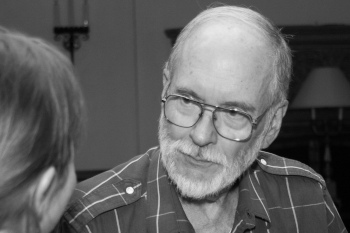
Del Butterfield dedicated his life to making things work and knowing why. The Baringer family, historians by vocation and avocation, knew how consequential individual and communal action could be.
Del Butterfield and Ann Baringer Butterfield prized history, university education, and the Disciples Divinity House. That inspired them to provide for the Baringer Butterfield Fund by establishing a charitable gift annuity through the Christian Church Foundation to benefit DDH. After Del Butterfield’s death this fall, their gift of $109,335 came to DDH. Part of their marvelous gift is the legacy of their names and their lives.
Ann Baringer and her twin sister, Susie, were born in Champaign-Urbana, Illinois, the only children of William and Louise Baringer. When their father accepted a teaching position at Tulane University, the family moved to New Orleans. William E. Baringer was a scholar of Abraham Lincoln whose writing focused on “how we got Lincoln,” as one commentator put it. His first book, Lincoln’s Rise to Power (1937), was hailed as an exhaustive treatment of Lincoln’s swift rise to the presidency and to greatness. He later wrote A House Dividing (1945) and Lincoln’s Vandalia (1949). He served as Executive Director of the Lincoln Sesquicentennial Commission and edited its two-volume, Lincoln Day by Day: A Chronology 1809-1865. During World War II, Louise Baringer, who had a fine voice, was called upon to serve as a cantor for a synagogue. In 1947, the family moved to Florida where Mr. Baringer became a professor at the University of Florida.
Ann and Susie eventually enrolled at the University of Florida as undergraduates. Another student, Del Butterfield, met Ann while he was waiting tables at her sorority. Ann earned her BA in Elementary Education and Del earned his BSE in electrical engineering. They married in 1958. Graduate studies took Del into the rapidly emerging field of nuclear engineering, in which he earned the MSE in 1965.
In 1966, Mr. Butterfield accepted a position with Commonwealth Edison, eventually becoming Director of State Nuclear Programs. Later he became a personnel administrator for Commonwealth Edison. When he began, nuclear power plants were being built rapidly. He later recalled how the fire at the Tennessee Valley Authority’s Brown’s Ferry plant and the later incident at Three Mile Island spurred a significant increase in the safety of the plants. He eventually became a personnel administrator for Commonwealth Edison. The Butterfields raised two children, Lawrence and Susan. Ann Butterfield became the lead interpreter/educator for the Naper Settlement living history museum.
The Butterfields had moved to the Chicago area at the urging of Ann’s sister, Susie, and her husband, Al Boynton. Mr. Boynton, the son of a prominent Disciples minister and the first PhD graduate in nuclear engineering from the University of Florida, worked at the Argonne National Laboratory. Early meetings for the new First Christian Church of Downers Grove were held at Susie and Al Boynton’s home. William E. Crowl, then a third-year Disciples House Scholar, was the founding minister.
It was through the congregation that the Butterfields began their long relationship with the Disciples Divinity House. After DDH Dean W.B. Blakemore served as interim minister at Downers Grove, he invited Del to join the Board of Trustees. Mr. Butterfield would serve as a trustee for thirty-five years and with four DDH deans. He gave invaluable leadership to personnel, facilities, and investment matters.
In 1994, the Butterfields retired to DeSoto, Wisconsin. Del served the village as its president. Later the village named the street where they had lived the “Del Butterfield Honorary Parkway.”
Ann’s parents, William and Louise Baringer died in 2000 and 2004, respectively. Ann’s sister Susie Baringer Boyton also died in 2004 (Al Boynton predeceased her). When Ann Baringer Butterfield died in 2007, she was the last in a line of Baringers.
In 2009, Del remarried; he and his second wife, Lois, eventually relocated to Florida. He remained devoted to his alma mater, the University of Florida. He died on September 28 in Florida. (See the related In Memoriam to Mr. Butterfield.)
The Baringer Butterfield Fund lifts up Ann’s family name, their shared devotion to university education, and Del’s service to the Disciples Divinity House. We give thanks for these gifts of leadership, history, and friendship, richly shared with the Disciples Divinity House, and for lives dedicated to making things work and understanding how and why they do.
In Memoriam: L. Del Butterfield

Lawrence Del Butterfield, who served as a trustee for thirty-five years, died on September 25 in Florida. We give thanks for his gifts of leadership and friendship, richly shared with the Disciples Divinity House, and for a life dedicated to making things work.
Born in 1937, Del Butterfield studied at the University of Florida, where he earned BSE and MSE in the emerging field of nuclear engineering. He accepted a position with Commonwealth Edison in Illinois, and eventually became Director of State Nuclear Programs. Later he moved into personnel administration. He met Ann Baringer while they were students at the University of Florida. They married in 1958 and raised two children, Lawrence and Susan. After retirement, they built a house in Desoto, Wisconsin, that overlooked the Mississippi River; they called it “Winemakers’ Bluff” after its location and Del’s hobby. He also worked in the hardware store and served the village as its president.
Mr. Butterfield, who was a member of First Christian Church of Downers Grove, joined the Board of Trustees in 1974 at the invitation of Dean Blakemore. Over the next decades and until 2009, he gave crucial leadership to the Board, working also with Deans Browning, Gilpin, and Culp. He served as Secretary of the Board, Assistant Treasurer, member of the Finance Committee, and with particular excellence, as chair of the House Committee. He was generous with his time and attention, strengthening the Board's work in wide range of matters from personnel, investments, the complete renovation of the kitchen and dining room, the refurbishment of the chapel and its pipe organ, to the minutiae of making things work.
In 2005, the Butterfields established the Baringer-Butterfield Fund through the Christian Church Foundation with a charitable gift annuity to benefit DDH. The fund’s name remembers that Ann Baringer Butterfield was the last in a line of Baringers. Her father, William E. Baringer, was a scholar of Abraham Lincoln, and Ann herself served as the lead interpreter for the Naper Settlement living history farm in Naperville, Illinois. Ann Butterfield died in 2007. Del Butterfield is survived by second wife, Lois, whom he married in 2009, his children and their partners, and two grandchildren.
Beginning again

The academic year begins Monday, September 27. Disciples Divinity House has welcomed three new Disciples Scholars and a dozen other new student residents from around the world and from varied backgrounds and religious traditions. Along with a full house, we have a full schedule for Monday dinners and programs. DDH and the wider University have strong Covid protocols in place to make this and other in-person learning possible. Monday dinners, brought in from local restaurants this fall, will be held outdoors when weather allows. Renovations to the courtyard and interior, completed during the past three summers, provide welcoming and well-lit large gathering spaces.
Monday programs, offered in a slightly compacted schedule due to pandemic considerations, promise to stretch our minds and hearts. PhD student and MDiv graduate, Rachel Abdoler, will preach for the opening chapel service. She is the inaugural recipient of the Barbara and Clark Williamson Scholarship. MDiv student and chapel coordinator, Benny VanDerburgh, will speak in November. We welcome new organist, Charles Hayes, and look forward to music from the Flying Chalices. W. Clark Gilpin leads the Disciples History and Thought Seminar again this year. Forums will feature faculty member Sarah Pierce Taylor, visiting scholar Kimberly Redding, our lauded landscape architect Ernie Wong, and two alumnae, Kristel Clayville and Disciples General Minister and President Terri Hord Owens.
Welcome New DDH Scholars
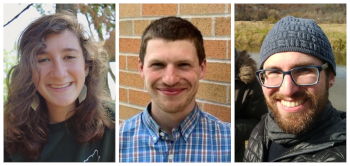
Justin Carlson, Marissa Ilnitzki, and Charlie Platt enter the MDiv program this fall as Disciples Divinity House Scholars. They will be joined by new ecumenical and interfaith residents.
Justin Carlson seeks to infuse congregations with a deepened understanding of how ideas and practices of embodiment manifest in different traditions. “As a Disciple, I had been brought up constantly hearing the refrain that all are welcome at the table. Physically excluding people from the church during times when they need community support the most seems so contrary to what I understand to be the core of Christianity: building a community where all can share their gifts.” He grew up in First Christian Church in Minneapolis, where he remains very active. In the Upper Midwest Region, he has served in the camp program and on the search committee for the new regional minister. He is a 2012 graduate of Carleton College, where he majored in Music. He is presently a legal editor for the State of Minnesota’s Office of the Revisor of Statues. He is the Oreon E. Scott Entering Scholar.
Marissa Ilnitzki is the second recipient of the new Martin Family Scholarship, which recognizes promise for leadership. She is a 2017 graduate of Georgetown University where she majored in sociology and minored in environmental studies. After graduation she gained experiences in community leadership, wilderness education, and social services in Washington State with the Jesuit Volunteer Corps at the Pascal Sherman Indian School, on the staff of the Lutheran retreat center Holden Village, and as a family support specialist in Seattle. Raised Roman Catholic, her journey to ministry has been nourished by women leaders in United Methodist, ELCA, and UCC churches. She reflects, “The table of communion has been extended to me throughout my life. The ability to be a Disciples Divinity House Scholar would give me the connections to create my own table of welcome.”
Charlie Platt is the William N. Weaver Entering Scholar. He earned a MSW from the University of Minnesota (2020) and a BA from St. Olaf College, where he graduated cum laude in 2016 with majors in social work and religion. Currently a therapist at the Boynton Mental Health Clinic at the University of Minnesota, he brings social work experience in church, educational, and community settings, and he has served as a member of the Lutheran Volunteer Corps at Holden Village and of Macalester Plymouth UCC in St. Paul. “My experiences have shown me how participating in community and spiritual experiences have an essential place in the flourishing of all human lives. Being a leader in shaping these experiences is a core part of my vocation.” During his year as a case manager at the Lincoln Park Community Shelter in Chicago, he participated in Root and Branch Church, which provided a model and mentors for Disciples ministry.
In Memoriam: Clark M. Williamson

The Disciples Divinity House mourns the death of Clark M. Williamson, distinguished alumnus, trustee, and beloved friend. He died after a short illness on June 26, in Indianapolis. He was 85.
Love of questions brought Clark Williamson to DDH as a student in 1957 and to pathbreaking work as a Christian theologian. A pioneer in Post-Holocaust theology, important voice in Process Theology, and leading Disciples theologian, he was the author of seventeen books, including his systematic theology, Way of Blessing, Way of Life: A Christian Theology (1999), which was recently published in Korean translation. He was the Indiana Professor of Christian Thought Emeritus at Christian Theological Seminary and its former Vice President and Dean. An ordained minister in the Christian Church (Disciples of Christ), he was also a deeply appreciated member of Central Christian Church in Indianapolis, having served as Elder, a longtime volunteer in the Free Clothing pantry, and as teacher. He was a valued colleague, mentor, and friend, and, for many, a teacher without parallel.
In 2007, he was elected to the Board of Trustees of the Disciples Divinity House. In 2015, he was honored with the Distinguished Alumnus Award. He served as the Honorary Co-chair, with JoAnne Kagiwada, of DDH’s 125th Anniversary Celebration in May 2019. This April, the Barbara and Clark Williamson Scholarship reached full endowment at $250,000, largely due to Barbara and Clark’s generosity over many years and a magnificent pledge from Clark to the 125th anniversary campaign. It will recognize "excellence in theological thinking that furthers understanding and accountability between traditions," and be awarded for the first time this fall. It expresses the conviction that thinking critically about faith and about the accountability of Christianity to other faiths is essential for spiritual life and leadership.
Clark Murray Williamson was born November 3, 1935, in Memphis, Tennessee. He grew up in the Taylor Memorial Christian Church in Memphis, where his grandfather, J. Murray Taylor, was minister. His grandfather viewed the principal calling of the minister to be that of teacher of the Christian faith, a perspective that animated Clark's own approach to theology, church, and ministry.
When Clark Williamson arrived at the Disciples Divinity House in 1957 from Transylvania College, he thought, “I had finally found a place where I was intellectually and spiritually at home.” He had completed the AB in religion and philosophy at Transylvania that spring. The school’s president, Irvin Lunger, told Williamson about DDH. Lunger was a DDH alumnus. Williamson entered the Divinity School as a Disciples Divinity House Scholar, and earned BD (1961), AM (1963), and PhD (1969) degrees from the University of Chicago. He served as assistant dean of the Disciples Divinity House and as interim minister of University Church. He was also Paul Tillich's assistant for Volume III of Tillich's Systematic Theology. Tillich referred to Williamson as “my Englisher.” For his part, Clark had a raft of stories to share about “Paulus.”
Barbara Unger was a student working in the office of the dean of the Divinity School when she and Clark met. She earned AB (French) and AM (Linguistics) degrees from the University and taught high school French before serving as executive director of the ACLU in Indiana, in the US Attorney’s Office, and in the Federal Court House in Indianapolis. They raised one child, Scott. He graduated from the College, making for six University of Chicago degrees in a family of three. Barbara Williamson died in October 2016. Barbara and Clark are survived by Scott and his wife Eva, and beloved grandchildren Jolie and newly-born James, who live in Washington, DC.
In 1966, Mr. Williamson joined the faculty at Christian Theological Seminary (CTS) in Indianapolis. Advancing quickly to associate and then full professor, he became the first occupant of the Indiana Chair of Christian Thought and served as Dean and Vice President of Academic Affairs, retiring in 2002. He also served as a visiting professor at the Ecumenical Institute of the World Council of Churches in Bossey, Switzerland, and at the Claremont School of Theology. Transylvania University honored him with the Distinguished Achievement Award (2002) and with the Doctor of Divinity (honoris causa) (2005).
Seeking to identify anti-Judaism and anti-Semitism in Christian theology and to correct it was one of the most persistent themes of his life and work. As he said, “I have come to see that loving questions and loving strangers (who bring their questions with them) is a requirement of Christian faith. Even more, it is a requirement of any authentic spirituality or pastoral leadership. After Auschwitz, unquestioning faith is pernicious.” His 1982 book, Has God Rejected his People?, recognized the searing questions put to the Christian community by the Shoah. Later books continued this work, including A Guest in the House of Israel: Post-Holocaust Church Theology (1989) and the three-volume lectionary commentary series co-authored with Ron Allen that provided guidance for Christian preaching without “blaming the Jews” or “dismissing the Law,” as two of the subtitles put it. He served on the Committee on the Church and the Holocaust of the United States Holocaust Memorial Museum and was a member of the Christian Scholars Group on Judaism. A 2003 conference at CTS discussed his contributions to Jewish-Christian conversations and to post-Holocaust theology.
He described his work, in part, as rethinking Christian faith in conversation with contemporary issues and points of view. Ron Allen, colleague at CTS and coauthor with Williamson of several books, observes that Clark was self-consciously a “church theologian,” that is, a theologian who intended for his work to strengthen the church. “While his published works show remarkable depth and precision, they are written in ways that are immediately accessible. His writings are marked by epigrammatic expressions that bespeak a mind that is simultaneously penetrating, insightful, critical, visionary, restive, and playful. He could devastate a whole argument put forward by a student or colleague with a single humorous expression, and was occasionally too willing to do so.”
In books and in numerous journal articles, Mr. Williamson developed an interpretation of God and the world through the lens of neo-process thought. He interpreted the gospel as the dipolar news of God’s unconditional love for each and all, including for elements of nature, and God’s command for justice for each and all. The dominant witness and animating center of his life was the unrelenting awareness of being graciously loved beyond measure and the consequent mission of enhancing the knowledge of that love in church and world, and calling for love in every heart, every relationship and every circumstance. A favorite characterization of God came from Alfred North Whitehead: that God’s nature “is best conceived, [as] that of a tender care that nothing be lost.” Read more about his work.
We give thanks for his life, his questions and insight, his tenacity, generosity, and wisdom. A memorial service will be held at Central Christian Church in late September. Memorial gifts may be made to the Disciples Divinity House at the University of Chicago, Transylvania University in Lexington, Kentucky, Planned Parenthood of Indiana and Kentucky, or the ACLU of Indiana Foundation.
In Memoriam: Don A. Pittman

Alumnus Don A. Pittman, the William Tabbernee Professor of the History of Religions Emeritus and former Vice President of Academic Affairs and Dean of Phillips Theological Seminary died June 26 in Tulsa, Oklahoma. He had joined the PTS faculty in 2000 after having taught for seven years at Tainan Theological College and Seminary in southern Taiwan, where he also served on the regional faculty of the Southeast Asia Graduate School of Theology. A leader in Disciples theological education for many years, he had also served as Associate Dean of Brite Divinity School and as a member of the Brite faculty for ten years. During Don Browning's deanship, he served as Associate Dean of the Disciples Divinity House and, during the 1983-84 academic year, as acting dean.
After earning a BA from Texas Christian University (1970) and a MDiv (1973) and MA (1976) from Vanderbilt University, he entered the University of Chicago Divinity School as a Disciples Divinity House Scholar. He earned his PhD from the University of Chicago in 1987, and later did postdoctoral studies at National Cheng Kung University, Tainan, Taiwan (1994-95).Trained as a scholar of Chinese Buddhism, he also gained historical and global perspectives on theology and ministry and expertise in cross-cultural studies.
His publications included Ministry and Theology in Global Perspective: Contemporary Challenges for the Church, co-edited with Ruben Habito and Terry Muck (Grand Rapids: Eerdmans Publishing Company, 1996) and Toward a Modern Chinese Buddhism: Taixu’s Reforms (Honolulu: University of Hawaii Press, 2001), plus numerous scholarly articles in English and Chinese. His keen mind and gentle spirit made him a treasured colleague in theological education and among the Association of Disciples for Theological Discussion (ADTD).
He died following a last fierce battle with Parkinson's disease. He is survived by his spouse, Nancy Claire Pittman, who is the President of Phillips Theological Seminary, his mother, Eve, and three daughters, Merillat, Katheryn, and Debra. A memorial service will be held at 2 pm CDT Friday, July 2, at Harvard Avenue Christian Church in Tulsa; it will be livestreamed. Interment will be the following week in Fort Worth, Texas. Read the PTS obituary and more about his contributions.
Backyard renovation underway this summer

DDH's backyard will be renewed as a place of gathering, relaxation, and respite. Can you imagine sitting together outdoors for Monday dinners? A patio, grill, serving area, farm table, and strings of lights will make that and other student gatherings possible. What about finding a quiet retreat to talk with a colleague or read a book? There will be hammocks, a swinging bench, a fire pit, plus raised beds for vegetables, herbs, and flowers. Ernest Wong of Site Design developed the plans in consultation with the trustees and a group of students. The work starts in July.
Barbara and Clark Williamson Scholarship: Loving questions and loving strangers
Love of questions brought Clark Williamson to DDH as a student in 1957 and to his pathbreaking work on post-Holocaust theology and against anti-Jewishness in Christian theology. The Barbara and Clark Williamson Scholarship, now fully endowed at $250,000, will recognize "excellence in theological thinking that furthers understanding and accountability between traditions." Friends and family joined with Mr. Williamson and the Board of Trustees on April 24 to inaugurate the scholarship.
The scholarship will be awarded for the first time this fall. It will support future generations of students, including, on occasion, students in the Divinity School from other traditions to make possible their residence and participation in shared life and thought at DDH. It expresses the conviction that thinking critically about faith and about the accountability of Christianity to other faiths is essential for spiritual life and leadership. As Clark has said, “I have come to see that loving questions and loving strangers (who bring their questions with them) is a requirement of Christian faith. Even more, it is a requirement of any authentic spirituality or pastoral leadership. After Auschwitz, unquestioning faith is pernicious.”
When Clark Williamson arrived at the Disciples Divinity House in 1957 from Transylvania College, he thought, “I had finally found a place where I was intellectually and spiritually at home.” He earned BD, MA, and PhD degrees at the University of Chicago Divinity School as a Disciples Divinity House Scholar. He became an architect of post-Holocaust Christian theology, the author of more than twenty books, and the Indiana Professor of Christian Thought at Christian Theological Seminary (now emeritus). Barbara was a student working in the office of the dean of the Divinity School when they met. She earned AB (French) and AM (Linguistics) degrees from the University and taught high school French before serving as executive director of the ACLU in Indiana, in the US Attorney’s Office, and in the Federal Court House in Indianapolis. Barbara Williamson died in 2016. The determination to grow the endowment was further catalyzed when then-MDiv student Rachel Abdoler completed an internship at Congregation Beth El Zedeck in Indianapolis that Clark was instrumental in helping to arrange. He saw the quality of leadership and thought that was possible in a DDH student.
Barbara and Clark Williamson began to build the fund in gratitude for excellence in theological education and scholarship. The endowment was built through their commitment over twenty-two and half years, with a little help from some friends, and completed through Mr. Williamson's magnificent commitment to the 125th Anniversary Campaign. The Board of Trustees acted formally to establish the Barbara and Clark Williamson Scholarship at its April 24 meeting, which was held remotely.
Family and friends of Clark surprised him by joining the Board of Trustees for the formal action. The surprise celebration continued with the announcement of the inaugural recipient of the scholarship: Rachel Abdoler. Rachel Abdoler is now a fourth-year PhD student in the History of Christianity. She studies Christian theological texts written in Arabic against a backdrop of Christian and Islamic polemical writing, and particularly the hermeneutical strategy of Arabophone Christian, Butrus al-Sadamantī, who wrote in a thirteenth-century Copto-Islamic milieu. She spoke movingly, recounting how Clark had been a mentor during her 2014 internship in Indianapolis and dinners shared with Barbara and Clark. In all those ways and more, she explained, she felt as though she had already been a recipient of this scholarship. Her comments were followed by remarks from Rabbi Dennis Sasso, of Congregation Beth El Zedeck, who blessed his dear friend Clark, the memory of the late Barbara, the scholarship, and Rachel, its first recipient.
Jha elected to the Board of Trustees

Sandhya Jha, author of four books and founder of the Oakland Peace Center, has been elected to the Board of Trustees. An alumna and 2006 graduate of the University of Chicago’s joint MDiv and Public Policy program, she is a consultant, community organizer, and serves with the Emerging Leaders Program at the Leadership Institute at Allen Temple. In addition to founding the Oakland Peace Center, she is its former executive director and current Connections Consultant for OPC—a collective of forty organizations working to create equity, access, and dignity as the means of creating peace in Oakland and the Bay Area. She serves as an anti-racism/anti-oppression trainer with Reconciliation Ministries for the Christian Church (Disciples of Christ) and, with Yvonne Gilmore, co-directs DDH’s Living Justice Project: An Anti-Racist Practicum. Her first book, Room at the Table (2009), a history of people of color in the Disciples of Christ, was followed by Pre-Post-Racial America: Spiritual Stories from the Front Lines (2014), Transforming Communities: How People Like You are Healing Their Neighborhoods (2017), and, most recently, Liberating Love (2020).
David Vargas, a member of the Board's Nominating Committee, stressed the importance of the "grass roots" perspective that Sandhya Jha brings to the Board's work of planning for and imagining the future of theological education at the Disciples Divinity House. Nominating Committee chair, Claudia Highbaugh, conveyed the committee's enthusiasm and welcome. Her three-year term on the twenty-one member board begins immediately.
David Nirenberg appointed dean of the Divinity School

David Nirenberg, who has served as interim dean of the University of Chicago Divinity School since 2018, has been appointed dean, University of Chicago President Robert J. Zimmer and Provost Ka Yee C. Lee announced. Nirenberg, the Deborah R. and Edgar D. Jannotta Distinguished Service Professor of Medieval History and Social Thought, is a leading scholar of the ways in which Jewish, Christian, and Islamic societies have interacted with and thought about each other. As interim dean, he has advanced the Divinity School’s efforts to bring informed discourse on religion to a global audience.
Prior to leading the Divinity School, he served as executive vice provost, focusing on issues of critical importance related to administrative coordination between the divisions and the College. He also strengthened resources for graduate students, including serving as chair of the Graduate Education Committee, which assessed the current state of graduate education at the University. He previously served as dean of the Division of the Social Sciences from 2014 to 2018 and was the founding Roman Family Director of the Neubauer Collegium for Culture and Society. He holds an MA and PhD in history from Princeton University and an AB from Yale University.
His new term begins July 1, 2022, at which time he will take a one-year sabbatical. James T. Robinson, the Caroline E. Haskell Professor of the History of Judaism, Islamic Studies and the History of Religions, has agreed to serve as interim dean during this time. Read the original story on the University of Chicago News site.
Winter quarter begins January 11

Ayanna Johnson Watkins, Lead Organizer for MICAH (Memphis Interfaith Coalition for Action and Hope), a coalition of community and faith-based organizations, will preach for the first chapel service of the winter quarter on January 11. She is a joint MDiv and MA in Social Service Administration graduate and a current member of DDH's Alumni/ae Council. She previously led NBA's Incubate initiative, and had served as a new church minister in residence at DDH. She is back by popular demand after participating in a panel discussion during the autumn quarter.
She heads a calendar of diverse offerings for the quarter. On January 25, alums Tabitha Isner, a former Alabama congressional candidate, and Rob Wilson-Black, CEO of Sojourners, will discuss "Religion and the 2020 Election." On February 15, Erin Galgay Walsh, Assistant Professor of New Testament and Early Christianity at the Divinity School, will present, "Speaking in Her Voice: Late Antique Poets and Biblical Storytelling." On March 8, alumna and Gilead Church co-founder Rebecca Anderson will take up storytelling in a different vein with "Campfire Stories."
The quarter will also feature the preaching of House Scholars Aneesah Ettress and Sarah Zuniga in the February and March chapel services. W. Clark Gilpin advances teaching and learning with two sessions of the Disciples History and Thought Seminar, both in February. All programs will convene virtually during the winter quarter.
In memoriam: Eddie Evans Griffin

At DDH we knew Eddie Evans Griffin best as a key officer of the Board of Trustees, a mentor to students, and a lover of the Chapel of the Holy Grail. She was a pioneer in several realms. After receiving her bachelor’s degree from what is now Clark Atlanta University, she became the first Black student to enter (and to graduate from) the Master of Social Work program at the University of Illinois. "She took life on," her dear friend Dolores Highbaugh remarked. She died December 21, 2020, after having been in hospice care. She was 85.
Born August 10, 1935 to Myrtle and Lorenzo Evans, Eddie Lo Evans spent her formative years in Indianapolis, where her father, an academic, served as the first African American staff of the National Convocation in Christian education, beginning in 1947. (In 1960-61 he became one of the first group of the merger staff of the NCMC and UCMC.) After graduate school, she married John Griffin and moved to Chicago. He predeceased her. Most of her professional career was at the Chicago Child Care Society. She began as a case worker, working primarily with sexually active teen girls; she served as a field education supervisor for the University of Chicago's School of Social Service Administration. She became a senior administrator with CCCS and retired as Director of the Chicago Comprehensive Care Center.
In 1999, and within a few years after she was first elected to the DDH Board of Trustees, Eddie Griffin became an officer of the board. Her experience as a leader of nonprofit organizations, her commitment to higher and theological education, her mentorship of students, and her knowledge of the church in every manifestation, as well as her wisdom and skill in decisions and processes contributed decisively to the Board’s work. She served on the Executive Committee for twelve years: as Vice President from January 2005 until December 2011, when she stepped down from the board, and as Secretary from 1999 through 2004. She knew the student community well as a regular participant in Monday dinners, programs, chapel services, as well as at Convocation and other special events. She took special pleasure and solace in the Chapel of the Holy Grail.
She was an elder at Park Manor Christian Church and a longtime Sunday school teacher. At Park Manor she was also a chair of the board, sponsor of the college program, chair of the Christian Women’s Fellowship (now Disciples Women), and a member of the Spires Women’s Group. Mrs. Griffin was a leader within the general church and served on the General Board, the Time and Place Committee, and the New Church Start Committee. She wrote meditations for women’s groups. She worked with the Chicago Disciples Union. When she became the Moderator of the Christian Church in Illinois and Wisconsin (CCIW), she was the first Black female to hold that role. During that time, she was also elected Secretary for the Conference of Regional Ministers and Moderators. In 2012, she was recognized as one of three inaugural recipients of the CCIW’s Disciple of Merit award.
Eddie Lo Evans Griffin is survived by her sister Stacy Duke (King), son Brian (Luba), and grandchildren. A virtual memorial service was held on January 16 at Park Manor Christian Church.
Remembering Bob Bates
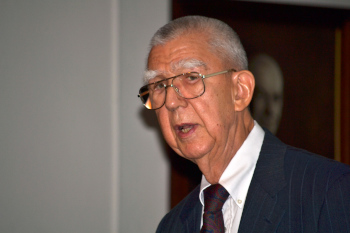
We are saddened to learn of the death of Robert Searle Bates (1950) on December 8 in Indianapolis. He was 92. He capped a lifelong career with Global Ministries by serving as the Area Executive for East Asia and the Pacific. Bob and Sue Bates began their careers as mission co-workers in India in the 1950s. He earned BD, MA, and PhD degrees at the Divinity School as a Disciples Divinity House Scholar.
He was born on September 22, 1928, in Shanghai, China. He attended high school in Connecticut and Pennsylvania. After graduating from Hiram College, he entered the University of Chicago as a Disciples Divinity House Scholar in 1950. He was ordained at University Church in 1953. In 1957, he married Margaret Sue Gillespie, and they went to India as mission co-workers, appointed by the United Christian Missionary Society. They worked alongside student Christian movements in Bangalore and Sri Lanka and taught at Leonard Theological College in in Jabalpur, Madhya Pradesh, India. They returned to the US in 1970. In 1974, he completed his PhD, which focused on Sri Lanka and the Sinhalese-Tamil conflict. They moved to Indianapolis in 1972, where he joined the faculty of Christian Theological Seminary as an assistant professor of Church and Urban Community, serving until 1976. He directed the Survey of Undergraduate Religious Studies in Colleges and Universities of Indiana, before beginning work with the Division of Overseas Ministries of the Christian Church (Disciples of Christ) in 1978. He served DOM as Executive Secretary for the Department of Interpretation and Personnel until 1983, when he became the Executive Secretary of the Department of East Asia and the Pacific of the Division of Overseas Ministries. He retired in 1993.
Bob and Sue Bates were members of Allisonville Christian Church and served in the first group of Regional Elders for the Christian Church in Indiana. He served on the DDH Alumni/ae Council. In 2010, on one of their return trips to DDH, the Bates presented a forum on their 2008 trip to Nanjing, China. Bob Bates’s earliest years were lived in Nanjing, China, where his father, M. Searle Bates, taught history at the University of Nanking. He left Nanjing at age 12 with his mother and brother before Japanese troops invaded China in 1937. His father helped to create the Nanking Safety Zone, which protected thousands of Chinese civilians while bearing witness to the atrocities that resulted in the massacre of 300,000 civilians and the rape of women and girls. Today, the Nanjing Massacre Museum remembers the tragedy and the heroism and courage of the international committee. In 2008, Bob and Sue Bates, with their daughters and grandchildren returned to Nanjing to pray for peace, to celebrate Bob’s 80th birthday, and to visit the museum. Sue Bates died in March 2019. They are survived by daughters Karen Bates Hudson and Kristen Bates-Scott and extended family.
Grateful for Yvonne Gilmore
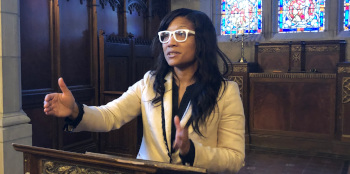
In Autumn 2013, Yvonne T. Gilmore became Associate Dean of the Disciples Divinity House. During these past seven years, she has invested intellect and imagination in DDH, in fact, she has exemplified critical thinking and vision for the DDH community and the wider church. She has also exemplified gratitude as she worked with family to bring the Teresa M. Gilmore Fund into being and with donors, especially younger alumni/ae. Among DDH students, she fostered camaraderie and conversation, shared worship and work, as she collaborated to arrange Chapel worship and Monday programs. Grants from the Oreon E. Scott Foundation and another from Reconciliation undergirded the “Constructive Theologies Project” and allowed her to partner with Cynthia Lindner and the Divinity School to sponsor several alumni/ae retreats. She has also worked with Disciples organizations across the country as an anti-racism trainer, and been a featured preacher and speaker at many events. With alumna Rebecca Anderson’s expertise and collaboration, they developed several “DDH StoryHour” events. Most recently, another grant from the Oreon E. Scott Foundation is allowing her to partner with Sandhya Jha for a new project entitled, “Living Justice: An Anti-Racism Practicum.” These are substantive initiatives that have shaped the House and its future.
At the end of November, she will conclude her work as Associate Dean in order to take on a new challenge and opportunity as Interim Executive Secretary of the National Convocation and Associate General Minister and President of the Christian Church (Disciples of Christ). We are already missing Yvonne Gilmore's style, spark, humor, insight and vision. Our consolation is that she has important work to do there, and, even more, we know she will always be a DDH alumna, and in that sense (and surely in many other ways), she will always be part of “the House.”
When her grandmother, Teresa Gilmore, died—who is remembered in the new fund—Yvonne wrote these words about her. They also apply to Yvonne herself: "She outgrew straight lines before I ever learned to describe them / she was an epic hymn sung in rounds worth repeating." The work of DDH and its students has been enriched and strengthened through the extraordinary companionship of Yvonne Gilmore—and by an epic hymn to move us as we go.
“The Precariousness of Care”

Cynthia Lindner, a DDH alumna and trustee who is Director of Ministry Studies at the University of Chicago Divinity School, wrote about "The Precariousness of Care" in late October. "Attending to each other and our communities is costly, messy, exhausting — and vital," she observes. It was one of her regular postings for Sightings, a publication of the Marty Center of the University of Chicago Divinity School. Read this and other reflections on religion in a time of pandemic and upheaval in her posts (navigation will take you away from the DDH website).
Richard Hunt sculpture to crown renovation; Jim and Tom Stockdale honored

A stunning bronze sculpture by Richard Hunt will crown renovations to the Disciples Divinity House that symbolize welcome and provide barrier-free access to the historic building.
A magnificent gift in honor of James E. Stockdale funded the courtyard redesign and related renovations to ensure access to the first floor. When University Christian Church in Seattle, Washington, ceased its common life in 2018, the congregation wanted to honor him, their esteemed former minister. The sculpture was commissioned by the family of Thomas V. Stockdale in his memory. He was Minister Emeritus of Union Avenue Christian Church in St. Louis.
One of the most important sculptors of our time, Richard Hunt became the first African American artist to have a major solo exhibition at the Museum of Modern Art in New York (1971). Over 150 of his public sculptures are displayed throughout the US, including in the National Museum of African American History and Culture and in a current solo exhibition at the Art Institute of Chicago.
Mr. Hunt's sculpture creates a conversation between fluidity and metal’s strength, form and transformation. In the accompanying photo, he and the model for the sculpture are seen in his Chicago studio. The artist's direct metal technique involves cutting, shaping, and welding sheets of bronze into a shape-shifting, ascending form.
Richard Hunt grew up in the Englewood neighborhood of Chicago and graduated from the Art Institute of Chicago. His history converges with that of Jim and Tom Stockdale on East 57th Street: as young man, Richard had taken classes at the University of Chicago and worked in the biology laboratories a block away from DDH where Jim and Tom Stockdale both studied.
James E. and Thomas V. Stockdale grew up in Peoria, Illinois, where both graduated from Bradley University before coming to the University of Chicago Divinity School as Disciples Divinity House Scholars, Jim arrived in Chicago in 1952; after graduation and ordination in 1956, he served Orchard Street Church in nearby Blue Island before moving downstate to Mount Carmel. In the mid-sixties, he was called to University Christian Church in Seattle, from which he retired in 1994. He was a member of the DDH Board of Trustees from 1985-2019.
Tom followed his older brother to DDH and the University in 1956, graduating in 1960. He served Disciples congregations in Michigan, Ohio, Kansas, Nebraska, and Maryland. From 1986-99 he was the senior minister of Union Avenue Christian Church in St. Louis. After his death in 2016, his family decided to commission a sculpture in his memory. They envisioned an angelic evocation that would remember him and inspire future generations of House Scholars; they discovered the remarkable artistry and vision of Richard Hunt.
Tom and Jim Stockdale were both devoted to congregational life and worship, to ecumenism, and to social and community outreach. Each loved the arts—music, visual arts, architecture, theater, theology, and poetry. In their lives and ministries—as in Richard Hunt's sculpture—form was ever being transformed, with God's spirit descending, ascending, and ever-moving amidst the earthen stuff of shared life.
The courtyard and sculpture will be dedicated on October 24 at 1:00 pm, CDT. The dedication will be videocast. RSVP here.
Awards recognize promise and scholarly achievement

Scholarship funds allow Disciples Divinity House Scholars to immerse themselves in learning without incurring significant debt. Student achievement and promise have been recognized with these special awards.
Several awards have been established or will be fully funded as part of DDH's 125th anniversary. These include the Martin Family Scholarship, being awarded for the first time to Joel Brown (see related article), and the Dr. Geunhee and Mrs. Geunsoon Yu Scholarship, which was newly awarded last year to Aneesah Ettress, a third-year MDiv student. The Yu scholarship recognizes high promise for innovative pastoral and intellectual leadership, especially within multicultural contexts.
The Edward Scribner Ames Scholarship for high academic achievement has been awarded to Mark Lambert, a PhD candidate in Theology, his dissertation is titled, “The Sacramental Sickness: The Perceptual Interplay between the Eucharist and the Leper-Christ in Medieval Theology.” The William Barnett Blakemore Scholarship for ecumenical vision and academic achievement has been awarded to Benny VanDerburgh, a second-year MDiv student, DDH librarian this year and co-convener of Open Space, a weekly ritual gathering for students at the Divinity School. Landon Wilcox, a second-year MDiv student and Head Resident this year, is the Bernard F. and Annie Mae Cooke Scholar. The scholarship was established by a spirited lay woman from Houston who prized excellence in ministry.
MDiv student Ross Allen is the recipient of the M. Elizabeth Dey Scholarship. LaSalle Street Church is his field education placement site. Emily Springer, second-year MDiv student, is the recipient of the Drum and Tenant Scholarship. Gilead is her field education placement site. Both of these scholarships were established by Katherine Dey, who wanted to remember her grandmother and dear friends.
The Henry Barton Robison Scholarship is awarded to Paige Spencer, a second-year MA student, for promise in biblical studies. Hiatt Allen was awarded the Rolland and Laura Frances Sheafor Scholarship which was established by a longtime DDH trustee who was the founding president of the Christian Church Foundation and his wife. A dual degree student, he is studying at the Harris School of Public Policy this year. Third-year MDiv Sarah Zuniga is the recipient of the M. Ray and Phyllis Schultz Scholarship which recognizes promise for congregational ministry. She is working as a digital content special at Crossroads Antiracism Organizing and Training this year. Ainsley Grey, first-year MDiv student, is the Oreon E. Scott Entering Scholar. Alexa Dava, first-year MDiv student, is the William N. Weaver Entering Scholar.
Martin Family Scholarship recognizes leadership; Awarded to Joel Brown

The Martin Family Scholarship for leadership in congregational ministry or scholarship and teaching, which was established at the Disciples Divinity House by Jerry and Donna Martin and Chad and Crista Martin, has reached the full funding level. It has been awarded for the first time in the 2020-21 academic year to House Scholar and PhD student Joel A. Brown.
The Martin family has seen the impact of DDH graduates firsthand. They established this scholarship to foster future leaders who will enrich the work of the church. Jerry Martin, a Disciples minister, got to know DDH and its students when he chaired the region’s Commission on Ministry. Donna Martin, who taught writing at a community college and was a lay leader in the region, especially appreciated the women graduates from the House she met in the wider church. An inheritance from her parents, Roy D. and Mary Zoe Heath, provided for the initial gift for this fund.
Chad Martin, their son, became a trustee. He had served with Kris Culp on the Administrative Committee of the General Board of the Christian Church (Disciples of Christ) and also had the connection to the House through his parents. A graduate of TCU with an MBA from Stanford University, and now a CFO of a software company, he brought financial and executive expertise to the work of the DDH Board of Trustees. Over the last twenty years, he has served as its treasurer, president, and, most recently, chair of the 125th Anniversary Celebration and Campaign. Crista Martin’s passion has animated the family’s commitment to women in ministry, congregations, and intelligent leadership.
Joel Brown, a PhD candidate in Religions in America, is the inaugural recipient. He studies how leaders of Black Chicago congregations shaped the Social Gospel movement. He recently served as editor of Sightings, the biweekly electronic publication of the Martin E. Marty Center at the Divinity School, and co-taught the Senior Ministry Project Seminar with Cynthia Lindner. Joel and Erin Brown with their daughter Margot, are resident assistants in the Undergraduate Housing System.
Courtyard Dedication

A beautiful courtyard renovation symbolizes welcome and provides barrier-free access to this historic building. It will be dedicated October 24, 2020, at 1:00 pm, CDT. It will be videocast. Please reply here.
University Christian Church in Seattle, Washington, has honored James E. Stockdale, their esteemed and beloved former minister, with a magnificent gift of $500,000 to the Disciples Divinity House. The gift has enhanced the welcome of this historic building by providing for an ingenious courtyard design and adaptations to the first floor.
An alumnus, longtime trustee, and impassioned advocate of the Disciples Divinity House, Jim Stockdale depicted the House as a “threshold to excellence” for its centennial celebration. How fitting that this gift removes barriers at that threshold. Click here to read more.
The videocast will be on a separate page of the DDH site, but also streamed on YouTube.
An Epic Hymn: Fund Honors Teresa M. Gilmore
_350x260.jpg?mtime=1600164951 "{alt_text}")
A new fund will honor Teresa M. Gilmore, music educator and grandmother of Yvonne T. Gilmore. By creating the fund, the Gilmore family pays tribute to her life and to the enduring power of sacred music, arts innovation, and courageous congregations. The Gilmore family also celebrates the 125th anniversary of the Disciples Divinity House, an institution to which they were first connected through her.
Teresa Marlene Gilmore (1933-2010) grew up in Coffeyville, Kansas, and attended the University of Kansas, receiving a Bachelor’s degree in Music Education in 1955. In 1956, she married Wilfred Gilmore and moved to Sioux City, Iowa, where Mr. Gilmore was serving in the Air Force; they finally relocated to Washington, DC. Soon after her arrival in DC, she met Arthur A. Azlein, a pastor who was introducing himself door-to-door in their neighborhood, and joined the new Michigan Park Christian Church. Azlein, a DDH alumnus, was a fellow Kansan. She was among the first African-American members of the congregation, and became the choir director for the senior choir and a member of the Christian Women’s Fellowship.
A pillar of music education and arts innovation, she was a music teacher in the DC Public School System for over thirty years. She co-directed the Region V Children’s Chorus, which performed throughout the DC metro area and at the 1984 World Exposition in New Orleans. Her passion for music and education converged at Michigan Park, where she steadfastly built the ministry of music for several decades. Some of the students that she mentored in the public schools joined the music ministry of Michigan Park and went on to become accomplished composers and musicians. These included Nolan Williams, who became the music editor of the African American Heritage Hymnal, a publication for which she served on the editorial committee.
She raised three children, Pamela (Steve Washington), David (Margo Gilmore), and Kesha Gilmore (Mark Rich), and, in time, grandchildren and great-grandchildren. Yvonne recalls, “When I gave birth to my youngest daughter, my grandmother shifted her retirement and came to live with me, making space on her journey to help with Assata, then a preschooler, while I pursued my MDiv, and later to care for my second daughter, Kharis.”
The final lines of a poem that Yvonne Gilmore composed after her grandmother’s death explain, She was a church charter of the gospel of better not more, better living not more stuff, better eating not more food, better rising for we are all phoenix … / she outgrew straight lines before I ever learned to describe them / she was an epic hymn sung in rounds worth repeating.
Incoming House Scholars and Residents

Two new Disciples Scholars will begin in their MDiv studies this fall. Alexa Dava is part of the leadership team at Gilead Church (alumna Rebecca Anderson is the founding co-pastor); she has been a parent educator at a Chicago nonprofit, and is a graduate of Wheaton College. Ainsley Grey is a 2020 graduate of Carthage College, where she majored in Asian Studies and studied in Japan. She has been a HELM Fellow; alumnus Beau Underwood was her pastor in Jefferson City, Missouri.
Two additional MDiv students are new DDH residents: Emily King, a 2019 graduate of Stanford University, and Shradha Jain, a 2019 graduate of the University of Southern California, where former DDH resident David Albertson was a mentor.
New and returning House residents have been moving in to DDH this week. Administrator Daette Lambert has been directing the effort, which involves reduced occupancy to allow for better social distancing, especially given the community kitchen and shared restrooms. Disciples Divinity House is committed to preventing the spread of COVID-19 and to supporting the health and well-being of its community.
Gilmore to provide leadership for National Convocation

Associate Dean Yvonne Gilmore will step into a national leadership position within the Christian Church (Disciples of Christ). Effective in December, she will become the Interim Administrative Secretary of the National Convocation of the Christian Church (Disciples of Christ) (NCCC) and the National Christian Missionary Convention (NCMC) for a two-year period. She will be charged with providing the leadership, management, and vision necessary to undergird the ministries of the NCCC and the NCMC, which are historic organizations of Black Disciples. The Administrative Secretary's office is located in the Office of the General Minister and President in Indianapolis. She follows the 17-year tenure of Timothy James. The news was announced on August 15 at the 26th biennial Session of the National Convocation.
"For the last seven years, it has been my great honor to serve as Associate Dean," she commented. "Furthering the pioneering educational work and mission of Disciples Divinity House in collaboration with Dean Culp, the Board of Trustees, staff, students, alumni/ae, and friends has been my daily privilege and joy. Partnering with emerging scholars, ministers, and 'thought leaders' at DDH and across the denomination to activate theological imagination to support and transform our church and world, and working to launch and lead the Constructive Theologies Project has been a rare gift to me. I am grateful for the enduring cloud of witness and inquiry, baptismal audacity, capacious hope, and creativity that I’ve encountered at our 'House.'"
Yvonne Gilmore's many accomplishments as Associate Dean include creative programming for chapel services and Monday forums; the Constructive Theology Project, which has been funded by the Oreon E. Scott Foundation and Reconciliation Ministry; support and mentoring of students; outreach to alumni/ae and support for the Alumni/ae Council; ongoing care for donors; editorial work with the DDH Bulletin, Grail Sightings, and DDH Facebook page; and support for the 125th Anniversary Celebration and Campaign and other major initiatives. In addition, she serves as one of the Core Trainers for the anti-racism/pro-reconciliation work of Reconciliation Ministries, and she is regularly sought as a guest speaker and preacher across the US.
"This list doesn't begin to capture how admired and beloved she is," added Dean Kris Culp. "She is loyalty personified. Her vision, ideas, and incisive analysis animate meetings and motivate participation. She is generous with insight and with care for others. And, she will always be a DDH alumna. The timing is right for her to move into this crucial arena of ministry and to build on her experience in organizational leadership and theological education and anti-racism work. I could not be more thrilled for her. We have so much to be grateful for and to anticipate eagerly in her next chapter of ministry and leadership."
She will continue as Associate Dean through this fall. That will allow for time for transition, and, importantly, for grateful celebration of her.
In memoriam: John E. McCaw, 1917 - 2020

John Emory McCaw, who had been DDH’s oldest living alumnus, died on June 29 in Des Moines, Iowa. He was 104. The son of a Disciples minister and one of four siblings, he was born March 3, 1917, to C.C. and Mildred McCaw in the small river town of Lomax, Illinois. His parents served as missionaries in the Philippines for three years before returning to the Midwest and eventually to Des Moines, where he became valedictorian of his high school class and graduated from Drake University. He would return to Drake to become the dean of its Bible College, which he led to full accreditation as Drake Divinity School (now defunct). After retirement, he continued to live on the southside of Des Moines, enjoying good health and beekeeping, gardening, fishing, writing newspaper editorials and two novels, and corresponding with many individuals.
John McCaw entered the Divinity School of the University of Chicago as a Disciples Divinity House Scholar in 1939 and earned his BD degree. He was later a Fellow at Union Theological Seminary and was awarded an honorary doctorate degree by Christian Theological Seminary in Indianapolis. In 1942, he married Maxine Mae Gambs, a concert pianist who studied at Drake University, the Curtis Institute of Music in Philadelphia, and Chicago Musical College. They would raise four children, Clayle, Milva, Maxhn, and Janine, and share 70 years of marriage before her death in 2013.
Mr. McCaw was a member of the Drake faculty from 1950 until 1982. He was instrumental in the construction of Medbury Hall and Scott Chapel and received numerous recognitions, including the Centennial Award, the Dawson Award, the Alumni Distinguished Service Award and the Drake Medal of Service. His leadership to religious and civic organizations included the Des Moines School Board, a mayoral commission, membership in Wakonda Christian Church, service to the regional and general church, and helping to establish the Des Moines Pastoral Counseling Center. In 2013 he established the John and Maxine McCaw Scholarship Fund for Prophetic Living, Teaching and Preaching, an endowed scholarship for seminarians which is administered by the College of Regional Ministers.
He is survived by three children, Milva Lou Sandison, Maxhn H. McCaw, and Janine G. McCaw Mack, and by their partners, children, and grandchildren. Memorial plans have not been announced.
Updates as the year ends
This was not the year we expected or could even have imagined when DDH began its 125th anniversary year. It has been a challenging but rewarding year. Many of DDH’s students finished the academic year in places they did not expect to be—literally dispersed by pandemic responses, sometimes also finding themselves in unanticipated emotional, intellectual, and spiritual places. The 2020 graduates are nevertheless ready to lead and to serve, even as they know the contexts of leadership and service are changing dramatically.
Confronting us all are realities of health precarity, global interdependency, racist brutality, and social suffering. DDH and its students have been challenged, stressed, horrified, enervated, activated, and animated by these days—often some of each in the same day. Students’ questions—about the nature of community, about how to teach, learn, worship, care, comfort, oppose injustice, bring about transformation, heal, and prevent harm—are lived and very real. Seldom have the purposes and contexts for pursuing vocations of ministry, teaching, and community leadership been more manifest than under the life-altering conditions of economic, social, and racial disparities of health and safety in which we are living.
We don’t yet know exactly what campus life will look like in the fall—the University will announce its plans later this month. But we do know that 3 entering DDH Scholars will join 18 returning Scholars plus additional ecumenical residents in a remarkable community of learning and support. By providing full scholarship support, durable connection, and learning that orients lifelong service, DDH will continue to advance preparation for vocations of vision, understanding, and transformation. Scholarships, staff, and building maintenance will not be reduced. Thanks to the generosity of alumni/ae and friends, DDH is as well situated as we could hope for facing current challenges.
For the time being, DDH’s physical offices remain closed, as does the rest of the University, but the building is still “home” for ten students, six of whom are international students. DDH will continue to be a physical home next fall, using valuable lessons learned for creating a safe space. Not all 23 student rooms will be occupied in order to allow for more socially distanced interactions. Sitting shoulder-to-shoulder at Monday dinners won’t be possible, but conversation will rise in new forms. Study will continue in the library. The Chapel of the Holy Grail will still beckon and orient. As ever, students will go forth to envision and build new communities and ideas.
For 125 years, alumni/ae and friends have given their fierce dreams, their creativity and canny, and their most demanding ideas, not only to DDH but to the world. When we began this academic year, we could not have imagined the scale and scope of changes that would overtake us. To affirm that we are, nevertheless, grateful for what is to come, is to dedicate ourselves to prepare for a future that we cannot fully anticipate and that, ultimately, we will receive from the hands of others. Kristine A. Culp, Dean
Fanfare for 2020 graduates

DDH's 125th academic year concluded on June 12 with an online fanfare for the graduates, Kate Gerike, Kevin Gregory, Savannah Gross, and Victoria Wick, including a short celebration, blessing, and sending forth. All four received the Master of Divinity degree. House Scholar Victoria Wick will provide leadership for the Christian Temple in Baltimore this summer during the pastor's sabbatical; this fall she will return to Chicago for extended Clinical Pastoral Education at Northwestern Memorial Hospitals. Her senior ministry thesis was entitled, Salvation Stories. Kate Gerike, whose senior thesis addressed climate change, misplaced hope, and the power of God in the anthropocene, will complete her internship year with an ELCA congregation in Minnesota. Savannah Gross, who like Gerike was an ecumenical DDH resident for all three years of the degree, is now living in Alabama and considering next steps in her journey as a theologian. Kevin Gregory, who has served as DDH's librarian, has been called to service two United Methodist congregations in Minnesota. Special congratulations to Victoria Wick and Kate Gerike who received the Divinity School's highest recognition of MDiv graduates, the John Gray Rhind Award, for excellence in academic and professional training and promise of significant contribution to public ministry.
Lambert awarded dissertation fellowship; other DDH Scholars recognized

Mark Lambert, a PhD candidate in Theology (pictured), has been awarded a Dissertation Fellowship by the Louisville Institute for 2020-21. His project, "The Sacramental Sickness: The Aesthetic Interplay between Leprosy and the Eucharist in Historical Theology," appraises the relationship between stigmatic illness and historical sacramental theology, especially the medieval Franciscan interpretation of leprosy alongside the sacrament of the Eucharist. Joel Brown, a PhD candidate in Religions in the Americas, has been selected by the Divinity School for the Alma Wilson Teaching Fellowship to support a teaching a course in the College, "Race and Religion in Chicago," that will draw on his archival research. Andrew Packman, a PhD candidate in Theology, was awarded a Dissertation Completion Fellowship by the Divinity School for his work, “The Racial Bondage of the Will: Recalcitrant Moral Self-Frustration, Social Affections, and the Tenacity of Structural Racism.”
MDiv students Aneesah Ettress and Benny VanDerburgh (also pictured) are recipients of Walker Ministerial Scholarships for 2020-21. Named in memory of Disciples leaders Granville T. and Erline Walker, the award recognizes outstanding promise in ministry, particularly in the area of preaching.
Announcements about DDH and COVID-19
Effective 3/17 and continuing until further notice, the physical DDH offices will no longer be open on a daily basis. Administrative staff will work remotely. We look forward to hearing from you by email, telephone, mail, and on facebook.
All University of Chicago courses will be taught remotely for the spring quarter. DDH scholarship recipients will receive stipendiary and scholarship support as planned for the spring quarter.
Approximately half of the usual number of students will continue living at DDH during the spring quarter; we believe that this decreased number will help minimize everyone's chances of exposure to the virus. Building maintenance will continue with enhanced cleaning protocols. We are all practicing vigilance for each others' health and learning new habits of mindfulness for each others' well-being.
Monday chapel services, dinners, and programs will be suspended for the spring quarter. Guest rooms will not be available for rental, and groups may not schedule meetings in the building until further notice. The Board of Trustees will hold its April meeting remotely, and the Alumni/ae Council will postpone its meeting until the October.
DDH is following the lead, recommendations, and guidelines of the University of Chicago. Additional details and resources, including health-related contact information, are available at the University’s COVID-19 website, which is constantly being updated.
These are unusual times and unusually stressful times. Many things basic to everyday student life and the wider context of our lives seems to have shifted and to continue to shift rapidly. I and the DDH staff are committed to this community and its health and safety, as well as to easing whatever stresses we can. We are grateful, too, for the support of alumni/ae and friends, to how our connections and care extend across the miles and the generations.
Kristine A. Culp, Dean
Duncan and Nguyen begin service as trustees

Patricia Duncan and Vy Nguyen have begun elected terms on the Board of Trustees of the Disciples Divinity House, effective January 1. They are both DDH alums.
Patricia "Tish" Duncan brings the perspective of a rising biblical scholar and professor to her service on the Board. An MDiv and PhD graduate of the University of Chicago, she is Assistant Professor of Religion at Texas Christian University in Fort Worth, Texas. She is a New Testament scholar, widely admired teacher, ordained Disciples minister, and the author of Novel Hermeneutics in the Greek Pseudo-Clementine Romance. One of her students, Paige Spencer, became a House Scholar this past fall when she entered the MA program in the Divinity School. She and her family live in Fort Worth.
Vy Nguyen is Executive Director of the Week of Compassion. As the relief, refugee, and development mission fund of the Christian Church (Disciples of Christ), Week of Compassion works with partners to alleviate suffering throughout the world. He brings global and ecumenical awareness, many years of experience building relationships among churches, volunteers, and partner organizations, and nonprofit expertise to the work of the Board. Previously he worked with Church World Service and the Lutheran Volunteer Corps. An MDiv alumnus of the University of Chicago, and a graduate of Texas Christian University, he is an ordained Disciples minister. He and his family live in Alameda, California.
Distinguished trusteeship: Constance Battle and Jim Stockdale

The Disciples Divinity House is grateful for the sage and generous leadership of Constance U. Battle and James E. Stockdale, and for the many years their work has oriented and undergirded DDH’s mission. Dr. Battle’s service was toasted at an event at her home in November. Mr. Stockdale’s service was celebrated during the 125th celebration in May.
Constance Battle, a distinguished physician, nonprofit executive, and professor of medicine, was elected to the Board in 2003. Dr. Battle chaired the Scholarship Committee for several years and brought keen insight about leadership to Board discussions. A Roman Catholic laywoman from Maryland, she sometimes framed her observations as being from an “outsider,” but, in fact, she has known about the Disciples Divinity House and its work for many years.
Dr. Battle first became acquainted with DDH through alumnus Arthur A. Azlein. From 1973-95, she served as Chief Executive Officer and Medical Director of the Hospital for Sick Children in Washington, DC, where she worked closely with him as he chaired the hospital’s board and served as the minister of the nearby Michigan Park Christian Church. Dr. Battle eventually served as the personal representative for Arthur Azlein’s estate, for which DDH was the sole beneficiary.
Dr. Battle attended Trinity College and the George Washington University School of Medicine and Health Science. In 1986 Dr. Battle was named president of the American Medical Women's Association, and in 1994 Washingtonian magazine recognized her as a Washingtonian of the Year. She has served as the chief executive for the National Museum of Women in the Arts and for the NIH Foundation. She would return to GW to teach pediatrics in the School of Medicine and Health Sciences, as a trustee and an alumni association officer, and, beginning in 2003, as a faculty member in the School of Public Health and Health Services. She received numerous teaching awards and is the editor of the textbook, Essentials of Public Health Biology (2009).
James Stockdale arrived at the Disciples Divinity House as a member of the entering class of 1952. After ordination, he served two congregations in Illinois, Orchard Street in Blue Island and First Christian in Mount Carmel. In the mid-sixties, he was called to University Christian Church in Seattle, Washington. He followed another alumnus, Robert Thomas, and the congregation continued to be a beacon of progressive ministry and community engagement. He served until retirement in 1994.
Recognized as an active and articulate advocate for the House, and bringing a love of interpretation, architecture, and the arts, Jim Stockdale was elected president of DDH's Alumni Council in 1984 and, two years later, to the Board of Trustees. From 1998-2001, he served as its vice president. At different times, he chaired Development and House Committees, and he served on the Nominating Committee. He served on the Centennial Campaign Committee, and it was his phrase that became the theme for DDH’s Centennial, “Threshold to Excellence.”
In Memoriam: Russell M. Fuller

Russell M. Fuller, entering class of 1948, died at home in Ann Arbor, Michigan, on January 15. He was 95. For forty years, from 1955 until his retirement in 1995, he served Memorial Christian Church in Ann Arbor; for his entire life, he worked for peace and justice.
"We find it impossible to describe the exponential power that Russell and Barbara Fuller generated in our local and global community, except to say that they aspired to live by Micah's call to do justice, love kindness, and to walk humbly with God. Their example inspired all who knew them," the obituary in the Ann Arbor News observed. He died just one day before what would have been his and his beloved late wife Barbara's 72nd wedding anniversary.
Russell Fuller was born in Kansas City, Missouri, on February 23, 1924, to Frank H. and Katherine M. Fuller. Following service in the Navy, he received an AB from the University of Michigan--as did Barbara Stauffer. They married in January 1948. That autumn, both began graduate studies at the Divinity School of the University of Chicago, where he entered as a Disciples Divinity House Scholar and earned his BD degree and she would earn a Masters degree. In those years, DDH did not grant funding to women; in later years, Barbara claimed her rightful place as an alumna. They both served on the DDH Alumni/ae Council and participated in other DDH events.
He was ordained in 1951 and served pastorates in both Chicago and Tucson. The Fullers returned to Ann Arbor in 1955, when he became pastor of Memorial Christian Church (MCC), now Journey of Faith Christian Church. "He was, first and foremost, our pastor," the congregation remembers. "He continued this tender, attentive care long after his formal retirement, visiting with folks over tea after church and hosting a standing Friday morning breakfast gathering for 'the old timers' and anyone else who'd come along. In addition to sharing God's love through this ministry of presence, Rev. Fuller's passion for justice was contagious." He was active in regional and general church work. The Fullers led forty family camps for the Michigan Region.
In the 1960s, he served as a member and chairperson of the Ann Arbor Human Relations Commission, the Ann Arbor Police Community Relations Commission, and the Civil Rights Coordinating Council. He was involved in the Vietnam War Peace movement and in early efforts for gay rights and AIDS patients. A member of the Disciples Peace Fellowship, he and Barbara helped found and later worked on the staff of the Interfaith Council for Peace and Justice in Ann Arbor. She directed a Disciples program of reconciliation between the people of the US and Vietnam beginning in 1980. He coordinated the local CROP Hunger Walk for several years.
A voracious reader, Mr. Fuller worked his way through Sojourners' list entitled, "Reading the Classics May Save White Souls," this past summer. He treasured weekly Skype conversations about theology, politics, social issues, and more with Diane Moore of Harvard, a mentee and mentor. He was distressed by the growing divisions in our nation and world and the effects of privilege and inequality.
He is survived by his children, Barbara (Kelvin Seifert), Rusty (Jamie Saville), and Kit/Katherine, and four grandchildren. "He is also survived by the Winnells, the Thanksgiving Community (especially his McCrae girls), every kid who grew up in MCC, and too many others to name, but who call him theirs." He was preceded in death by his wife Barbara in 2014 and their son Robby. A celebration of his life will take place in Ann Arbor on February 29 at 10:30 am, with luncheon reception to follow.
Grateful for what is to come - in 100 seconds

"Disciples Divinity House is so many things..." Current students and trustees reflect on the meaning of the House during this 125th anniversary year. View this new video on youtube or go to DDH's facebook page. We are grateful for what is to come and grateful for your support.
Katherine Dey extends an extraordinary legacy
.JPG?mtime=1576766006 "{alt_text}")
Katherine A. Dey was a lifelong member of the Disciples of Christ in part because her grandmother, who raised her, had seen the need for a congregation in northern Virginia and, in 1913, co-founded what would become the Wilson Boulevard Christian Church in Arlington. Katherine became one of the first two women elders of that congregation and the first female board chair in the Capital Area region.
During her lifetime, Katherine Dey also established two scholarships at the Disciples Divinity House: the M. Elizabeth Dey Scholarship in honor of her grandmother, and the Drum and Tenant Scholarship in honor of dear friends. She died in October 2017, at age 96. After a final gift was received this fall, her bequest of $465,601.88, had increased the total endowment for the Dey Scholarship to $365,576, and for the Drum and Tenant Scholarship to $299,616.
Like her grandmother, and also like her friends Florence Drum and Flo’s mother, Eleanor Tenant, Katherine Dey was a doer in the church and in life. She lived modestly in a two-bedroom home across from the public library in Arlington, Virginia. But, to use a phrase from the parable in Luke 12, she was rich toward God and others.
She knew what dedication and hard work meant. During World War II, she had moved to Florida to serve as a “Wendy the Welder”—that is, welding parts of ships and planes before “Rosie the Riveter” could even begin. During her 32-year career with the National Security Agency, she drove a car pool for the long daily commute to Fort Meade, Maryland. After retirement, she volunteered full-time for the local Red Cross and supported the humane society and her congregation, First Christian Church of Falls Church, Virginia.
Her generous estate gift was preceded by great generosity and attention during her lifetime. She built the scholarships through annual gifts, beginning in 1979. She corresponded with successive deans at DDH and, after the scholarships were first awarded (in 1993 and 1995), with their recipients.
“Dear Dean Culp,” she wrote in 1995. “To start off with, please call me Katherine. My grandmother, M. Elizabeth Dey (which is pronounced DIE) and I always refer to her as Mom, was born on December 17, 1876, the 4th of 10 children, on a farm in the Shenandoah Valley of Virginia. Being 4th in line she quickly learned how to care for others.”
She continued, “Mom died in July 1968 at 91½ years old and because of her life, her concern for others, her religious convictions and insight into human nature and what she meant to me I felt something should be done to mark this. … In 1979, I saw the opportunity to establish a memorial to Mom in a way I thought best reflected her impact upon the church and humanity in general. Thus, the establishment of the M. Elizabeth Dey Fund.”
DDH alumnus Ray Schultz had been the minister at Wilson Boulevard since 1966. His pastorate was important to Ms. Dey, as well as to Ms. Drum, who had served on the pulpit committee that called him. He introduced Katherine Dey to DDH, and embodied its spirit.
The first recipient of the Dey Scholarship was Stephanie McLemore, who has now served for many years as the chaplain of the University of Lynchburg. Danielle Cox, one of Stephanie’s students who is now a senior minister in Avon, Indiana, became a recipient of the Drum and Tenant Scholarship. Perhaps most gratifyingly, Lee Hull Moses, another Dey Scholarship recipient, became one of Katherine’s own ministers. (Lee is now chief of staff in the Office of the General Minister and President of the Christian Church, Disciples of Christ.)
“Wow! You sent us a winner!!,” Katherine wrote on September 19, 2004. “Rev. Lee preached today and I think she went over great…. And do you know what—it’s an irony—or whatever you want to call it—but today would have been Florence’s (Drum) 80th birthday!! Wow—if that’s not something—!!!!”
What an extraordinary gift and legacy Katherine Dey has passed on to next generations of ministers and leaders from her grandmother, her church, her dear friends, and through the accumulation of her steadfast “doing,” generosity, and faithful attention. That is something. Indeed.
Inaugural Yu Scholar Announced
Aneesah Ettress, a second-year MDiv student, has been named the first recipient of the newly endowed Dr. Geunhee Yu and Mrs. Geunsoon Yu Scholarship. The scholarship recognizes high promise for innovative pastoral and intellectual leadership, especially within multicultural contexts.
Selection of the recipient is guided by the examples of Dr. Geunhee Yu and Mrs. Geunsoon Yu, two remarkable individuals whose intelligence, faith, love, and leadership have profoundly shaped the Christian Church (Disciples of Christ) and their own family. From 1992 until his retirement in 2011, Dr. Yu served as the inaugural Executive Pastor of the North American Pacific Asian Disciples (NAPAD). He had been the first among the NAPAD community to earn a PhD in Religion. Under Dr. Yu’s leadership, the number of NAPAD congregations grew exponentially, many new cultural and language groups became part of NAPAD, diverse young leaders were nurtured, and educational initiatives were created.
Ms. Ettress is a 2016 graduate of Occidental College. A post-baccalaureate fellowship supported her her work on an initiative to transform Occidental College’s Arts & Humanities curriculum. Recently she was selected as the Hannah Holborn Gray Graduate Student Fellow in Digital Scholarship at the University of Chicago Library.
The newly endowed Dr. Geunhee and Mrs. Geunsoon Yu Scholarship will help to ensure full tuition, stipend, and housing for innovative religious leaders and emerging scholars and to make possible opportunities for extended internships and study-travel for generations to come.
2019 Incoming Scholars
Welcome new House Scholars Emily Springer (MA), Danny Sanchez (MDiv), Landon Wilcox (MA), Aneesah Ettress (MDiv), Monica Carmean (MDiv), Paige Spencer (MA), Benny VanDerburgh (MDiv), and Ross Allen (MDiv). Two are active at Chicago area new church starts. Monica Carmean is a member of Gilead Chicago, and Aneesah Ettress is a member of Root and Branch. Three come from Disciples-related colleges: Emily Springer (Bethany), Paige Spencer (TCU), and Landon Wilcox (Lynchburg). We are also pleased to welcome new House Residents Yi Liu, Dhruv Nagar, Abdullah Naveed, Linden Smith, Ania Urban, and Jiayi Zhu.
125th Celebration continues at GA

DDH’s 125th anniversary celebration continued at the biennial General Assembly of the Christian Church (Disciples of Christ) in Des Moines, Iowa. Alexis Vaughan Kassim, Alumni/ae Council co-president, welcomed about one-hundred alums and friends to a luncheon on July 23.
The Council wanted to mark the anniversary in a special way, and decided to honor two individuals. “So many alums are doing great work in academia, local churches, in justice and mission organizations, and our Disciples general ministries,” she explained. “David Vargas and Clark Gilpin exemplify not only the excellence of that work, but also its breadth.” Mr. Gilpin and Mr. Vargas each spoke in response to the award, and their remarks are published here. Garry Sparks, Associate Professor of Religious Studies at George Mason University, introduced them.
Alumni Beau Underwood and Tim Lee, who helped lead the Assembly as its First and Second Vice Moderators were acknowledged. Disciples General Minister and President Terri Hord Owens, an alumna, brought greetings and spoke of her admiration of the honorees. Dean Kris Culp sounded the theme, “Grateful for what is to come,” in her remarks.
Continuing the anniversary theme, President of the Board of Trustees April Lewton invited participation in the 125th anniversary campaign. The goals support the enduring mission of the House: to provide scholarships and immersive learning opportunities, and to make the historic building more accessible and welcoming. Over $2.5 million is already pledged or committed. “Each and every gift conveys hope for and belief in a future where community, curiosity, and courage continue to shape the world.”
Associate Dean Yvonne Gilmore and current student Victoria Wick concluded the program, leading the hymn of gratitude: O God, we praise thy holy name; God of Love, O God of Love. Our gratitude we here proclaim, hand in hand and heart to heart. For every gift, for every friend, for fellowships that never end….
Convocation 2019

On June 14, Disciples Divinity House marked the conclusion of its 124th academic year and celebrated its graduates. Among them were Disciples MDiv graduates Jack Veatch and Ellie Leech, AMRS graduate Devon Crawford, and ecumenical resident Noriko Kanahara, who earned her PhD in the Department of History. Veatch was ordained on July 14 at the First Christian Church in Stow, Ohio, on July 14, and will study at the Ecumenical Institute of the WCC in Bossey, Switzerland, next year. Leech, a member of Chicago Christian Church, will continue to serve children and youth there while she completes CPE and other ordination requirements. Look for the inspiring Convocation address by Allen V. Harris, DDH trustee and Regional Minister of the Christian Church in the Capital Area, entitled, “Reviving Our Passion for Faith Seeking Understanding: The Wilderness Imperative for Now.”
125th Anniversary Campaign announced: $4 million for scholarships, internships, and accessibility

The trustees have launched a $4 million campaign to undergird scholarships, to create new immersive learning opportunities, and to enhance accessibility to our beloved “House.”
For 125 years, the Disciples Divinity House has fostered an atmosphere electric with possibilities for excellence in ministry, scholarship, and public leadership. Its singular residential scholarship program and intellectual community, offered in connection with the University of Chicago Divinity School, prepares men and women to be the creative thinkers and courageous leaders needed in the church and wider world today.
“Plans for the 125th anniversary have been in the works for five years,” explained trustee Chad H. Martin, who is chair of the 125th Anniversary. “And believe it or not – the most difficult part of the entire planning process was determining our theme. Of course, we bask in the history of the House. And rightly so: DDH, for being a three-story building on the corner of 57th Street and University Avenue, with a full-time staff that you can count on one hand, has had a super-sized impact. That is worth celebrating.”
“However, no one—not the trustees, alumni/ae, dean, staff, or students—wants to describe DDH only in terms of what has been done in the past. So, when Larry Bouchard offered the phrase, grateful for what is to come, we knew that captured the essence of our celebration.”
“As part of preparing the House for what is to come, we are raising funds to support and enhance its mission for the next 125 years,” Martin announced at the Anniversary Dinner on May 25. “We started the silent phase a year ago – and the response has been overwhelmingly positive and generous. Much of this generosity is expressed through commitments that will fully endow at least six new scholarships at $250,000 each. In fact, we were able as a Board yesterday to formally create the Dr. Geunhee and Mrs. Geunsoon Yu Scholarship. THAT is our mission in action, and evidence the campaign is already a success.”
“And to give a sense for the level of generosity that has already been expressed in the silent phase, over $2.5 million is already pledged or committed. We have already raised over 60% of our overall $4 million goal, with another significant amount in the commitment process. But we still need to raise additional funds.”
Cash gifts may be made through pledges that will be fulfilled over the next three years. And any estate gift that evidences the house as a future beneficiary will be counted. Each and every gift conveys hope for and belief in a future where community, curiosity, and courage continue to shape the world.
That generosity will support three crucial purposes: 1) Funding for critical ministry and scholarship and, closely related, 2) funding for internships and immersive learning. An expansion of scholarships, both in number and in innovative use of funds, will help ensure that students are ready to provide critical ministry and scholarship for our globalized and swiftly changing world. Additionally, we want to raise 3) funding to ensure the House is a welcoming place. “One of the most unique things about the House is that it remains a ‘house’ – a physical place for students, staff, and community to intersect, " Martin observed. "We want the House to be a welcome place to all, and we think addressing first floor accessibility takes us in the right direction for the next 125 years.”
We give thanks for the remarkable legacy of the Disciples Divinity House of the University of Chicago as we celebrate its 125th anniversary, and for the individuals, churches, and organizations who have made that legacy possible. In that spirit, we are also grateful for what is to come.
2019 Senior Ministry Projects

The spring schedule featured presentations of culminating projects by three June 2019 MDiv graduates: Chelsea Cornelius on "Becoming Real: A Neonatological Theology"; Ellie Leech on "By Their Fruits You Shall Know Them: Sexual Misconduct and Betrayal in Christian Congregations"; and Jack Veatch on "God Talk: Exploring Hip Hop as a theological conversation space through Kendrick Lamar's DAMN." Ms. Cornelius and Ms. Leech will be chaplain residents next year. Mr. Veatch will be ordained at First Christian Church, Stow, Ohio, on July 14, and study next year at the Ecumenical Institute in Bossey, Switzerland.